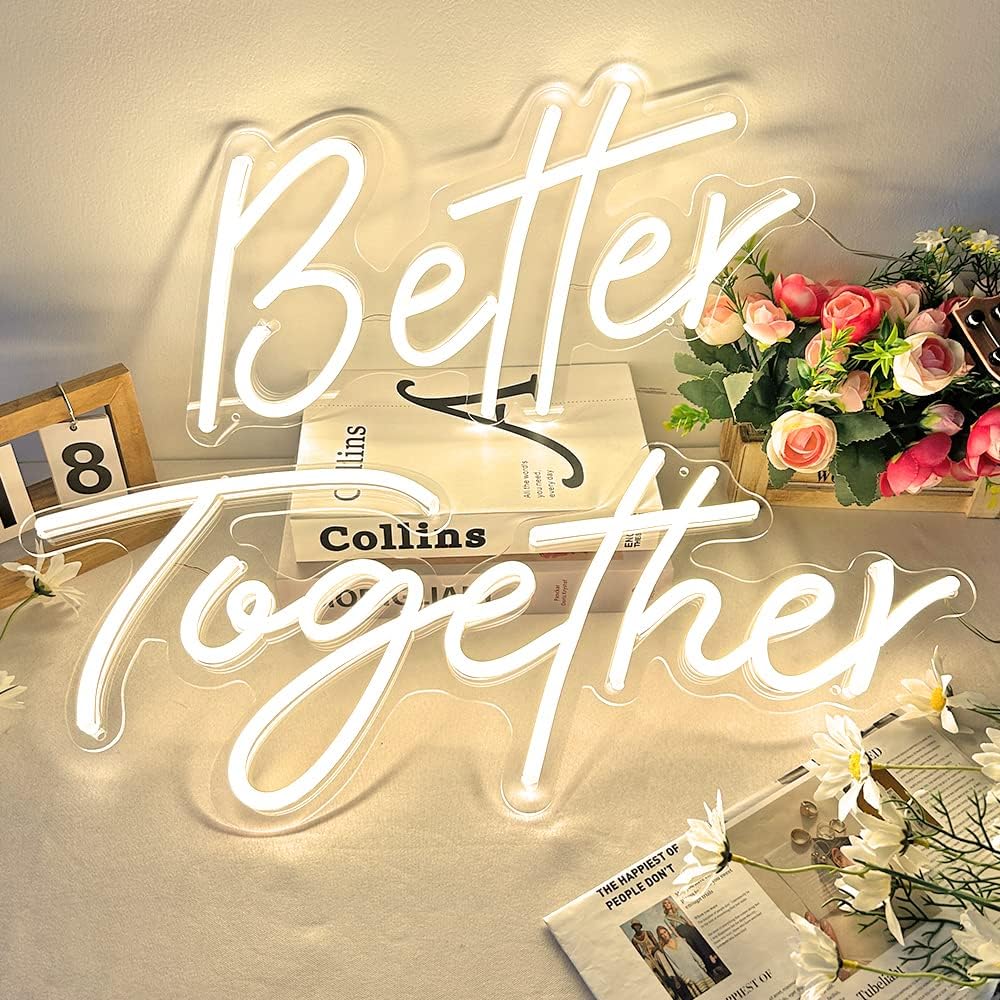
You’ve probably noticed the trend by now: neon signs as wedding backdrops are everywhere — arched acrylic panels, script phrases suspended above sweetheart tables, illuminated surnames looming over dance floors. A neon sign in this context is a light source and a design element simultaneously, which creates a problem most couples (and even some experienced event stylists) don’t anticipate until they see the photos. The sign that looked perfect to the human eye comes back from the photographer washed out, flickering in video, or glowing the wrong shade of white entirely. The culprit is almost never the fabricator’s craftsmanship — it’s three spec decisions made too early or not made at all: size relative to the backdrop, color temperature (the warmth or coolness of the light, measured in Kelvin — a lower number like 2700K is warm amber-gold, a higher number like 6000K is cool blue-white), and dimmer compatibility (whether the sign’s power supply can smoothly reduce brightness without introducing flicker that cameras pick up). Get these three dials right, and a neon sign earns its place in every hero shot. Get them wrong, and it’s edited out of the album.
This guide is built for event stylists, rental inventory managers, and design-forward couples who are already past the “what is LED neon?” stage and are now staring at a quote with options they need to evaluate intelligently. We’ll name the tradeoffs explicitly and end with clear decision rules for each scenario.
| EDITOR'S PICK[Divatla Better Together Warm Wh…](https://www.amazon.com/dp/B08GSR6J7Y?tag=greenflower20-20) | Mid-tier[SYLHOME Large LED Neon Light Si…](https://www.amazon.com/dp/B0BF4X4T9S?tag=greenflower20-20) | Budget pick[It Was Always You Neon Sign Wed…](https://www.amazon.com/dp/B0F4KQK5CK?tag=greenflower20-20) | |
|---|---|---|---|
| Message | Better Together | Happily Ever After | It Was Always You |
| Size options | 16" × 9" | 14.6" × 7.5" | — |
| Dimensions | 23" × 9" | 20.9" × 7.5" | — |
| Light color | Warm White | — | Warm White |
| Dimmer | — | ✓ | — |
| Voltage | — | 12V | — |
| Price | $99.99 | $59.99 | $32.99 |
| See on Amazon → | See on Amazon → | See on Amazon → |
Size Calibration: The Camera Frame Is Your Real Measurement Unit
Most fabricators quote sign dimensions in inches of total width — a 48-inch sign, a 72-inch sign. The mistake is sizing to the room. The right frame is the camera frame.
Wedding photographers typically shoot backdrop compositions at a focal length between 35mm and 85mm equivalent, framing the couple plus 18–36 inches of negative space on each side. That means the sign needs to be wide enough to anchor the composition without competing with the subjects for visual real estate. The Knot’s wedding backdrop lighting guide notes that signs intended as primary backdrop features — rather than accents — perform best when they span at least 60–70% of the frame width at the expected shooting distance.
Practical math for a sweetheart table backdrop:
A standard sweetheart table is 60–72 inches wide. Couples seated behind it create a frame roughly 80 inches across including chair clearance. At a 10-foot shooting distance (typical for a tight reception portrait), a 48-inch sign will appear undersized and will read as a prop rather than a statement piece. A 60–72-inch sign fills the frame correctly. For a full arch backdrop at 8–10 feet wide, the sign itself should be 48–60 inches wide to avoid competing with the arch perimeter.
By the numbers:
- Sweetheart table (2-person), 10 ft shooting distance: minimum 60 in. sign width
- Full arch backdrop, 8–10 ft wide: 48–60 in. sign width
- Dance floor installation, 15+ ft shooting distance: 72–96 in. for adequate visual weight
- Rule of thumb: sign width ÷ backdrop width should land between 0.55 and 0.75
Height is the overlooked axis. Script lettering in LED flex neon typically reads clearly at letter heights of 6 inches or above in photographs; below that, detailed letterforms (especially lowercase connectors in cursive) blur at standard print resolutions. If your quote comes back with 4-inch letter height to fit a width constraint, push back — or consider abbreviating the text.
Color Temperature: What “White” Actually Looks Like on Camera
This is where the most expensive post-production regrets originate. “Warm white” and “cool white” are used inconsistently across fabricators, and the actual Kelvin value matters enormously when the sign sits next to candlelight, Edison bulb string lights, or a photographer’s strobe.
Here’s the underlying issue: most wedding reception lighting runs between 2700K and 3200K — warm, amber-leaning. A sign specified at 6000K (cool white, blue-tinted) will clash visibly in photographs, especially in mixed-light conditions. The camera’s auto white balance will try to split the difference and usually fails, leaving the sign looking sickly green or the surrounding décor looking orange.
Architectural Digest’s feature on the neon design renaissance notes that interior designers sourcing signs for hospitality and event contexts have largely standardized on the 2700K–3000K range for installations that need to coexist with warm ambient light. Brides.com’s planning guide echoes this, advising couples to request warm white specifications when signs will be photographed under candlelight or Edison-style ambient lighting.
If you’re speccing for a photographer who shoots with flash or strobe: The calculus shifts slightly. A strobe-heavy shooter is effectively controlling the color balance of the scene, which gives more latitude — a 3500K sign reads well under flash conditions. But most documentary-style wedding photographers today shoot available-light or mixed-light, which means you want the sign to blend with the ambient warmth rather than fight it.
Practical request to make to your fabricator: Ask for the Kelvin specification in writing before ordering. “Warm white” without a number is not a spec — it’s a color category that varies by manufacturer. Sign Media Canada’s performance benchmark report identifies this as one of the most common sources of color mismatch complaints in event signage, noting that supplier interpretations of “warm white” range from 2500K to 3500K. Pin the number: 2700K for golden-hour or candlelit contexts; 3000K for mixed indoor/flash contexts; avoid anything above 4000K unless the aesthetic is intentionally cool and industrial.
On colored signs: Saturated hues — red, pink, blue — are more forgiving of ambient color temperature conflicts because the eye (and the camera) doesn’t expect them to match the surrounding warmth. The color temperature issue is almost entirely a “white” and “warm neutral” problem. If your sign is cherry red or rose gold pink, color temp is a secondary concern; focus instead on brightness consistency (more on that below).
Dimmer Compatibility: The Flicker Problem Nobody Warns You About
LED neon signs are driven by a transformer — a small power supply unit that converts wall current into the lower voltage the LED strip requires. Most off-the-shelf transformers are not designed for smooth dimming; they’re designed to run at full output. When you attach a standard household dimmer switch to one of these transformers, the result is often a flickering sign that’s invisible to the human eye in real time but devastatingly obvious in video footage and in still photos shot below roughly 1/200 second shutter speed.
Signs.org’s technical brief on transformer load ratings and dimmer compatibility explains this clearly: the flicker issue in LED neon installations stems from incompatibility between leading-edge (TRIAC) dimmer switches — the most common type installed in venues — and standard constant-voltage LED drivers. The solution is specifying a PWM-compatible transformer (Pulse Width Modulation — a dimming method that cycles the power on and off at high frequency rather than reducing voltage, which eliminates visible flicker) or a 0–10V dimmable driver, which communicates analog dimming commands to a compatible transformer.
Why this matters for event rental companies specifically: If you’re building rental inventory, every sign in your fleet should have PWM-compatible or 0–10V dimmable drivers as a baseline spec, because you cannot control what dimmer hardware is installed at each venue. A sign that flickers at 60% brightness in one ballroom and runs fine at another is a liability, not an asset. The upcharge for a quality dimmable driver — typically $15–$40 per unit at fabrication — is trivial against a $1,200 rental fee.
Speccing it with your fabricator: Ask explicitly: “Is this transformer PWM-dimmable, and what dimmer switch type is it rated for?” Reputable fabricators — including the major names event stylists are currently comparing, like Yellowpop, Voodoo Neon, and bespoke studio shops — will have a clear answer. If the response is vague or the sales rep doesn’t know what PWM means, that’s diagnostic information about the operation’s technical depth.
For battery-powered versions: Battery-driven LED neon signs (common in elopement and intimate venue contexts where outlet access is restricted) sidestep the venue dimmer problem entirely but introduce their own brightness consistency issue: as battery voltage drops over a multi-hour event, perceived brightness decreases. For a 4-hour reception, a sign running on a standard 5200mAh battery pack will often show visible dimming in the final hour. Operators report that doubling the battery capacity — or specifying a sign with a charging passthrough — eliminates this reliably. Aggregate reviewer accounts of battery neon in event contexts consistently flag this as the primary operational issue over time.
Making the Decision: If X, Then Y
Here’s the consolidated decision framework based on everything above:
If the sign is the primary backdrop focal point (sweetheart table or arch installation): Minimum 60 inches wide for a 2-person composition at 10 feet. Request 2700K warm white in writing. Specify a PWM-dimmable transformer. Budget $400–$900 for this tier of spec from a quality fabricator.
If the sign is a secondary accent (bar backdrop, photo booth prop, peripheral décor): 36–48 inches is sufficient. Color temperature is less critical because the camera isn’t centering on it. A standard non-dimmable driver is acceptable here if the venue lighting is fixed. Cost range: $180–$450.
If you’re building a rental inventory: Every sign should be 60 inches or wider (maximum versatility), specified at 3000K (the most camera-neutral warm-white option that works across lighting conditions), and fitted with 0–10V dimmable drivers. The incremental fabrication cost is recovered within 2–3 rentals compared to a sign that causes post-event complaints.
If the photographer is known to shoot available-light or documentary style: Prioritize 2700K over 3000K. The closer to candlelight color temperature, the more naturally the sign integrates with available-light exposures.
If the event involves video (ceremony livestream, highlight reel, social media reels): The flicker issue is non-negotiable — specify PWM-compatible or 0–10V dimmable drivers even if you plan to run the sign at full brightness all night. Video sensors are more sensitive to flicker than still cameras, and 60Hz flicker patterns interact unpredictably with common video frame rates.
The spec conversation with your fabricator shouldn’t take more than five minutes once you know what to ask. Kelvin number, transformer type, dimmer compatibility — three questions, in writing, before you approve the proof. That’s the difference between a sign that earns its place in the album and one that gets cropped out of it.