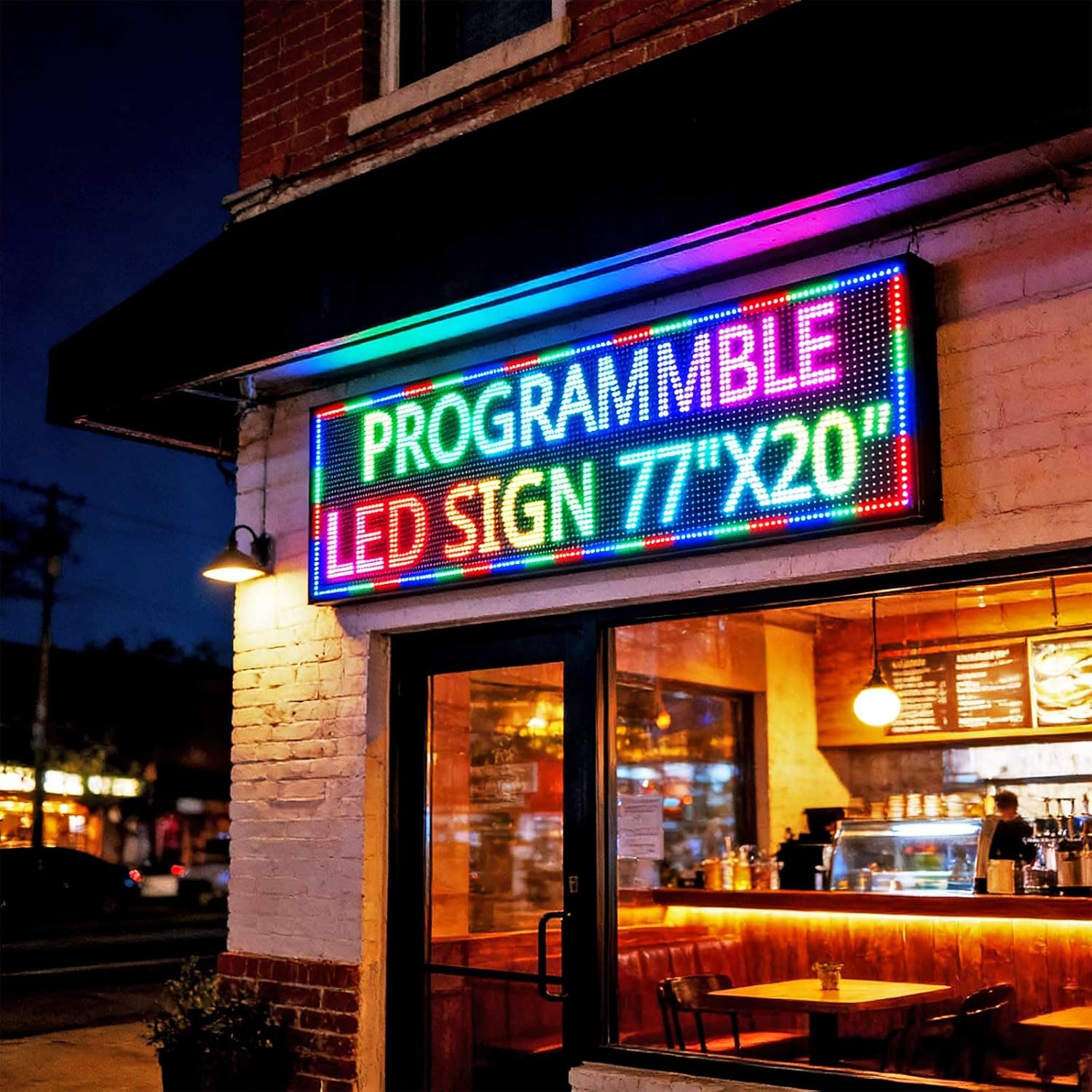
You’ve got a custom neon sign sorted for the back wall — the vibe is exactly right. But now you’re looking at the front window and realizing a static pink glow can’t tell the street about tonight’s happy hour, tomorrow’s pop-up, or the rotating seasonal menu you update every six weeks. That’s where programmable LED scrolling signs come in. These are display panels — usually made from a grid of tiny LED lights called a dot-matrix display — that let you type in messages, set animations, and change your content remotely, without touching the physical sign. Think of them as the dynamic, message-forward sibling to a fixed neon installation: less ambient-art energy, more operational muscle. This guide will walk you through when the switch makes sense, what the specs actually mean for your build, and how to make the call if you’re currently deciding between the two formats for a live project.
| EDITOR'S PICK[SpellBrite Custom Signs for Bus…](https://www.amazon.com/dp/B094QRKXZC?tag=greenflower20-20) | Mid-tier32'' X 17'' New Jumbo ULTRA BRI… | Budget pick[My Cinema Lightbox - RGB Color…](https://www.amazon.com/dp/B07DR9CK3Y?tag=greenflower20-20) | |
|---|---|---|---|
| Letter size | 6.3" | — | — |
| Letter count | 6 | — | 100 |
| Light modes | — | ✓ | — |
| Color changing | — | — | ✓ |
| Remote control | — | ✓ | — |
| Price | $192.00 | $155.95 | $21.99 |
| See on Amazon → | See on Amazon → | See on Amazon → |
The Core Tradeoff: Atmosphere vs. Agility
Static neon — whether genuine glass neon or modern LED flex-neon — earns its place in a hospitality buildout or boutique retail space because it is the aesthetic. A custom bent-glass neon logo above a bar back communicates permanence, craft, and identity in a way a scrolling matrix panel simply cannot replicate. Architectural Digest’s ongoing coverage of restaurant and retail interiors consistently notes that fixed neon and LED flex installations are specified precisely because they read as designed objects, not as signage hardware.
But permanent comes with a cost: inflexibility. If your message needs to change — daily specials, event dates, limited-time promotions, rotating taglines — a static sign means you’re paying for a new fabrication or papering your window with print collateral that undercuts the premium look you paid for.
Programmable LED scrolling signs solve the agility problem at the expense of aesthetic richness. They’re not trying to be art. Their value proposition is operational: one sign, infinite messages, updatable from a phone app or USB stick.
The decision frame, then, is not “which looks better” — neon almost always wins that fight. It’s: how often does your message need to change, and what is that flexibility worth per month?
Spec Breakdown: What the Numbers Mean on the Floor
If you’re comparing units right now, here are the specs that actually move the needle for a storefront application.
Pixel Pitch
Pixel pitch is the distance (in millimeters) between the center of one LED and the center of the next. Smaller pitch = more LEDs per square inch = sharper, more detailed image.
- P10 (10mm pitch): The workhorse of outdoor retail. Visible and legible from 15–40 feet. Spec sheets put it as the most common format for window-facing signs in the 24”×48” to 36”×72” range. Lowest cost per square foot.
- P6 or P8: Better for indoor applications or signs viewed from under 15 feet — think a host stand display or a short hallway. Higher cost, sharper render.
- P16 or P20: Highway-distance readability only. Not appropriate for typical retail frontage.
For most storefront windows where pedestrians are reading from 10–30 feet away, P10 is the practical sweet spot — legible without overpaying for resolution you can’t perceive at that distance.
Brightness (Nits)
Nits measure luminance output. Outdoor-facing signs fighting direct sunlight need to be rated at 5,000–8,000 nits or higher to remain readable during daylight hours. Indoor-only units typically run 800–2,000 nits. This is the single spec most commonly under-researched in first-time orders: owners report discovering their indoor-rated panel is essentially invisible through a west-facing window on sunny afternoons. Check the nit rating before you buy, not after.
IP Rating
IP stands for Ingress Protection — it’s a two-digit code that tells you how well a unit resists dust and moisture. For any sign with exterior exposure (window-mounted but facing inward in a humid climate, under an awning, or fully outdoors):
- IP54: Splash-resistant. Fine for covered outdoor or window-interior-facing installs in most climates.
- IP65: Dust-tight and jet-water resistant. The baseline for fully exterior mounting.
- IP67/IP68: Submersion-rated. Overkill for almost all retail; relevant for outdoor festival installations in high-rainfall regions.
The International Sign Association’s Digital Sign Specification Guide explicitly flags IP rating mismatches as one of the leading causes of premature LED display failure in retail environments.
By the Numbers
| Spec | Indoor Window Sign | Outdoor Facade Sign |
|---|---|---|
| Pixel Pitch | P6–P10 | P10–P16 |
| Min. Brightness | 1,500 nits | 5,500 nits |
| IP Rating | IP43–IP54 | IP65+ |
| Typical Size Range | 12”×36” – 24”×48” | 24”×48” – 48”×96” |
Programmable vs. Static Neon: The Financial Logic
Sign Media Canada’s retail signage benchmarks for 2025 put the average installed cost of a custom LED flex-neon sign (mid-tier fabricators, indoor, under 36 inches) at $350–$900. A quality programmable P10 LED scrolling panel in a comparable footprint — 24”×48”, outdoor-rated, with a Wi-Fi controller — runs $400–$1,200 installed, depending on the supplier and mounting complexity.
So the upfront cost differential is not dramatic. The divergence happens in total cost of messaging:
- A bar running three seasonal promotions per year and a weekly specials board would need either (a) three to four separate neon fabrications at $350–$900 each, or (b) one programmable panel updated remotely at zero incremental cost.
- Over 24 months, the programmable panel’s break-even against repeat neon orders typically lands at the second or third content change.
Forbes’s 2025 retail signage analysis notes that businesses with dynamic, frequently updated exterior signage report meaningfully higher walk-in conversion rates than those with static displays — attributed to perceived freshness and relevance rather than sign format alone.
That said: a programmable scrolling sign does nothing for brand atmosphere inside the space. The math above is a window-sign argument, not a case for ripping out your neon back wall.
Integration Considerations for a Live Build
If you’re currently speccing a project, here’s what to pressure-test before you commit.
Controller and Content Management
Most commercial-grade programmable LED panels ship with either a USB stick controller (load content at the sign) or a Wi-Fi/cloud controller (update remotely via app or browser dashboard). For any multi-location or staffed-venue application, the cloud controller is a non-negotiable — USB-only means someone physically walks to the sign to update it, which breaks down operationally within weeks. Verify the controller type is included in the quoted price; some suppliers bundle it, others itemize it separately at $80–$200.
Power Draw and Panel Integration
A 24”×48” P10 outdoor panel draws roughly 150–300 watts under full-brightness, full-animation conditions. That’s not trivial on a shared circuit. Signs of the Times magazine’s LED matrix technology overview recommends a dedicated 20-amp circuit for any panel larger than 18”×36” to avoid tripped breakers during peak-brightness periods. If you’re retrofitting into an existing retail buildout, confirm the electrical capacity before finalizing the sign size.
Dimmer and Scheduling Compatibility
Unlike a static neon sign — which pairs natively with most standard dimmer switches and smart-home systems — LED matrix panels typically control brightness through internal scheduling software, not external dimmer hardware. You can program brightness to drop at 10pm and ramp up at dawn, but you generally cannot put the panel on a Lutron or Leviton dimmer circuit. This matters in mixed-use spaces where a unified lighting control scene is part of the design brief. Plan accordingly, or confirm with the supplier before the electrical rough-in.
Mounting and Facade Compatibility
Programmable LED panels are heavier and bulkier than LED flex-neon — a 24”×48” outdoor unit commonly weighs 25–45 lbs with its cabinet. Window-mounting via suction or adhesive strips, which works acceptably for lightweight flex-neon, is not appropriate here. Budget for a dedicated wall mount, window frame bracket, or hanging cable system — and verify the structural capacity of the mounting surface, particularly for older or wood-framed storefronts.
When to Spec Which Format: The Decision Rules
This is where the practitioner guide earns its keep. Here are the clear “if X, then Y” calls based on the factors above.
If the sign’s primary job is brand identity and atmosphere — a logo above the bar, a signature phrase in a hotel lobby, a studio name on the retail wall — specify custom neon (glass or LED flex). The static format is doing design work that a matrix panel cannot replicate.
If the sign’s primary job is communicating variable information — daily specials, event dates, limited-time offers, rotating taglines — specify a programmable LED scrolling panel. The flexibility dividend pays for itself within two or three content cycles.
If you’re building a hospitality space with both needs — a branded back wall and a street-facing promotional presence — specify both formats for their respective jobs. A neon identity installation inside and a programmable panel in the window is not a redundancy; it’s a complete communication system. Budget-wise, this is achievable in most mid-range hospitality buildouts: a $600–$900 neon interior piece plus a $500–$900 programmable window panel is well within a $1,500–$2,000 signage line item.
If you’re an event rental company adding to inventory: static neon props rent for aesthetics; programmable panels rent for branded event activations where the client needs their hashtag or event name on a display. They serve different rental occasions — carry both categories if your client mix includes corporate events alongside weddings and editorial shoots.
If the installation is outdoors and fully exposed: verify IP65 minimum, 5,500+ nit brightness, and a dedicated power circuit before approving the spec. These are the three failure points the International Sign Association’s documentation flags most frequently in outdoor retail display complaints.
The bottom line: static neon and programmable LED scrolling signs are not in competition — they’re solving different problems. The mistake worth avoiding is speccing a static sign where operational flexibility is the actual need, or speccing a matrix panel where atmosphere is what the space requires. Get clear on the sign’s job first. The format decision follows logically from there.