If you’ve ever bought a glowing LED neon sign — the kind that spells out a phrase like “Good Vibes” or “Open” in flexible, color-lit tubing — you probably didn’t think much about year two. Most buyers think about the color, the size, the price. Longevity is almost an afterthought. But if you’re speccing signs for a bar buildout, a wedding rental inventory, or even a nursery that a toddler will eventually treat like a soccer ball, durability is the whole game. LED neon signs (the modern kind, built from flexible silicone or PVC tubing with tiny LEDs inside — not the fragile glass tubes of vintage signage) vary enormously in how long they last, which components fail first, and how sellers respond when things go wrong. This article pulls from real long-term owner accounts to map that variance — and gives you a clear decision framework for matching sign quality to actual use case.
The Long-Term Data We Have (And What It Actually Shows)
Honest longevity data on consumer LED neon signs is rare. Most review platforms capture the first-week impression. What makes the dataset worth analyzing here is a handful of reviewers who came back — months or years later — to update their assessments.
The three-year survivor. One reviewer of a moon-and-mushroom decorative sign explicitly noted that their sign had lasted “several years” — and context in the review dates the original purchase to approximately three years prior. That’s not a throwaway comment; that’s a meaningful data point. The sign was used in a home setting, mounted on a wall, and apparently never touched a dimmer issue or power supply failure in that window. For a decorative sign in the $60–$120 range, three years of daily-use survival is the upper bound of what you’d expect from spec-sheet projections (LED flex modules are often manufacturer-rated at 50,000 hours of total illumination, though real-world thermal cycling and power supply quality can erode that significantly).
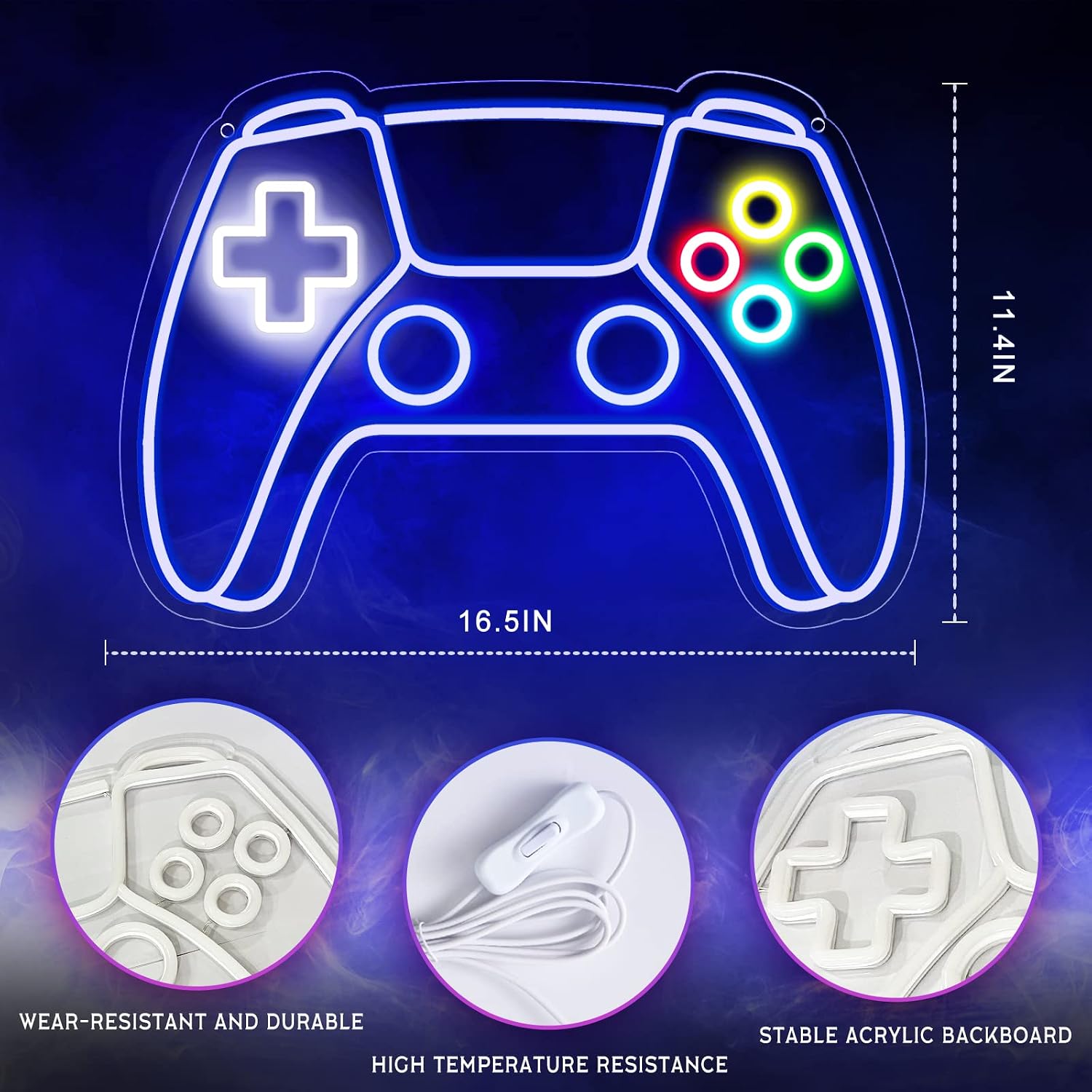
The almost-one-year pleasant surprise. A reviewer of a gaming-themed sign (the Kavaas model) noted — with visible relief — that it had been “almost a year and it still works.” That framing matters. The reviewer wasn’t bragging about durability; they were expressing surprise that it had lasted at all. That’s the baseline expectation problem at the budget tier: buyers are conditioned to expect early failure, so surviving eleven months feels like a win. Architectural Digest’s coverage of neon sign trends in 2024 noted this exact dynamic — decorative LED sign buyers frequently underestimate expected lifespan but also underestimate how quickly their expectations recalibrate downward after a category purchase.
The 33-day failure. Here’s the cautionary data point. One reviewer of a BZSXHFFW “Open” sign reported complete failure after 33 days of use — and the seller refused to accept a return. This is the starkest durability contrast in the dataset, and it’s instructive for a specific reason: “Open” signs are commercial-use products. They run longer daily hours than a decorative bedroom sign. They’re often left on for 8–12 hours per shift, near windows where thermal cycling (heat from sun exposure, overnight cool-down) accelerates component wear. The failure at 33 days suggests either a defective power supply, a driver circuit that wasn’t rated for continuous commercial duty, or both. The seller refusal compounds the damage — and signals that the brand wasn’t building in margin for warranty claims, which is a structural sign of low quality control investment.
The repeat-purchase signal. Perhaps the most commercially useful data point: a SELICOR reviewer returned in 2026 to leave a review for a sign purchased in 2024 — specifically to note they were ordering another. A two-year ownership window followed by a repeat commission is, in the sign business, the equivalent of a five-star rating with receipts. House Beautiful’s 2024 roundup of best home neon signs flagged repeat-purchase rate as one of the cleaner proxies for real durability satisfaction, precisely because it captures revealed preference rather than first-impression ratings.
The drop-test survivor. One reviewer of a “Happily Ever After” wedding phrase sign noted that the sign had fallen multiple times and survived with only a small chip in the acrylic backing — the LED tubing itself was undamaged. This aligns with what Apartment Therapy’s buying guide describes as the structural advantage of flex-tube LED construction: unlike glass neon, the silicone or PVC tube that carries the LEDs is inherently impact-resistant. The acrylic backer is the weak point, not the light source.
Which Component Fails First — And Why It Matters for Buying Decisions
Understanding failure modes helps you shop differently. LED neon signs have three main failure points, roughly in order of likelihood:
1. The power supply / transformer. This is the most common early failure in budget signs, and it’s almost always invisible at point of purchase. Budget signs often use unbranded driver modules with minimal thermal management. In commercial settings — or even a bedroom sign left on 24/7 — heat buildup in the driver degrades the capacitors that regulate voltage. Signs of the Times magazine’s 2024 coverage of LED flex signage noted that transformer quality is the single variable most correlated with long-term sign performance, and it’s the variable least disclosed by manufacturers in product listings.
2. The dimmer switch or control module. USB-powered decorative signs often use a small inline controller — a barrel-shaped module between the USB plug and the sign itself — that handles dimming and sometimes flicker/pulse modes. These are low-cost components. They fail at higher rates than the LEDs themselves, and when they do, the sign appears dead even though the tubing is fine. Importantly, these are often replaceable: a standard USB LED dimmer controller can be sourced and swapped without any soldering on most budget signs.
3. The LED strip inside the tubing. The actual light source is typically the last thing to fail, and when it does, it usually manifests as partial dimming in one section rather than total failure. Manufacturer-rated lifespans of 50,000 hours are for the LED elements themselves — not the full system. At 8 hours of daily use, 50,000 hours is over 17 years of theoretical LED life. Real-world failures happen long before that because of points 1 and 2.
The Commercial vs. Decorative Fault Line
The BZSXHFFW “Open” sign failure at 33 days illustrates a category mismatch that trips up buyers regularly: a sign designed and priced for decorative residential use being deployed in a commercial context.
By the numbers:
- Decorative home sign: ~4–6 hours/day average use, controlled indoor environment
- Bar/restaurant “Open” sign: 8–14 hours/day, potential window heat exposure, near door drafts
- Equivalent annual hours: ~1,500 vs. ~4,000+
At 4,000 hours per year, a driver module rated for 20,000 total hours (a common budget-tier spec) fails in five years in a home setting — but in under five years in a commercial one, with thermal stress compressing that window further. If you’re speccing for a bar or retail front, the decision rule is simple: you need a sign with an IP54-rated or better enclosure, a named-brand driver (Meanwell is the industry benchmark), and a seller that explicitly warranties commercial use. The price delta between a decorative sign and a properly-specced commercial sign — roughly $80–$150 vs. $200–$400 for equivalent phrase length — is real, but so is the cost of a failed sign and a seller who won’t return your messages.
Durability for Specific Use Cases: The Decision Matrix
If you’re sourcing for a rental prop inventory or a hospitality buildout, here’s how to map the data to actual decisions:
Wedding/event rental inventory. The “Happily Ever After” drop-survival story is genuinely reassuring for rental operators. LED flex construction handles transport and incidental contact better than buyers assume. What you need to manage: the acrylic backing (consider protective foam during transport) and the power supply (test every sign before each rental, not just after purchase). A sign that survives three years of home use may survive only 18 months of rental cycling — budget for 18-month replacement windows on high-use phrase signs.
Kids’ room or nursery. The flex tube construction is your friend here. The LED element won’t shatter. The real risk is cord and plug handling by curious hands — choose signs with recessed or wall-mounted drivers rather than inline USB controllers if the sign is within reach. Mount high. The acrylic backing can chip, as noted above, but it’s not a hazard.
Bar or restaurant front window. This is the highest-stress use case. Do not use decorative-category signs. Look for IP54 or IP65 weatherproofing ratings even for indoor window mounts (thermal cycling from window heat is real). Prioritize sellers who explicitly describe their driver specs and offer documented warranty coverage for commercial use. The BZSXHFFW failure-and-refusal scenario is not an anomaly — it’s the predictable outcome of mismatched spec-to-use-case.
Home décor, long-term installation. The three-year moon-mushroom survival and the SELICOR repeat purchase suggest that decorative signs in low-stress home environments can genuinely exceed buyer expectations. The main threat is power supply quality — and the best proxy for that is brand transparency. If the product listing names the driver supplier and specifies input/output voltage clearly, that’s a better durability signal than any number of five-star first-week reviews.
Frequently Asked Questions
How long do budget LED neon signs typically last with daily use? Based on published specs and aggregated long-term reviewer accounts, the realistic window for a budget decorative LED neon sign in residential use is 2–4 years with 4–6 hours of daily illumination. The LED elements themselves are rated far longer; it’s the driver and control components that compress real-world lifespan.
What part of a neon sign fails first — the LEDs, the dimmer switch, or the cord? Owners consistently report the power supply or dimmer controller failing before the LED tubing itself. The LED elements are often the most durable component in the system; the supporting electronics are typically the weakest link, especially in budget-tier signs.
Can I replace the dimmer switch on a USB LED neon sign if it breaks? On most USB-powered decorative signs, yes. The inline controller is a discrete component connected by standard plugs — a replacement USB LED dimmer can often be purchased separately and swapped without tools or soldering. Check whether your sign’s controller uses a standard 5V USB input before sourcing a replacement.
Are LED neon signs durable enough for a kids’ room where they might get knocked around? The flex-tube construction is more impact-resistant than most buyers expect — reviewer accounts include signs surviving repeated falls with only cosmetic damage to the acrylic backing. Mount the sign out of direct reach if possible, and choose models with wall-mounted rather than USB inline power controls to reduce cord hazards.
What should I do if my neon sign stops working after 30 days? Document the failure with photos and video immediately. Contact the seller in writing (email, not chat) within the first 48 hours of noticing the failure to create a paper trail. If the seller refuses a return or replacement, dispute the charge with your card issuer — most credit cards extend purchase protection to defective goods for 60–120 days. The BZSXHFFW seller-refusal case is a reminder that seller response is as important a quality signal as the sign itself.
Is it worth paying more for a sign that will last longer, or should I just replace a cheap one? For home decorative use, the math is genuinely close — a $90 sign replaced every two years costs about the same over four years as a $180 sign that lasts the full window. The real argument for spending more is commercial use (where a mid-cycle failure costs you revenue, not just the sign price) and rental inventory (where replacement frequency multiplies across your catalog). For a nursery name sign or a home office phrase sign, a well-reviewed budget option is a perfectly defensible buy.
The clearest takeaway from the durability data: the gap between the three-year survivor and the 33-day failure isn’t mainly about price — it’s about use-case match. A $70 decorative sign in a bedroom is not the same product as a $70 “Open” sign running commercial hours in a front window, even if they look identical in a listing. Match the spec to the use, watch the driver transparency signals, and the LED neon category delivers better longevity than its reputation suggests.