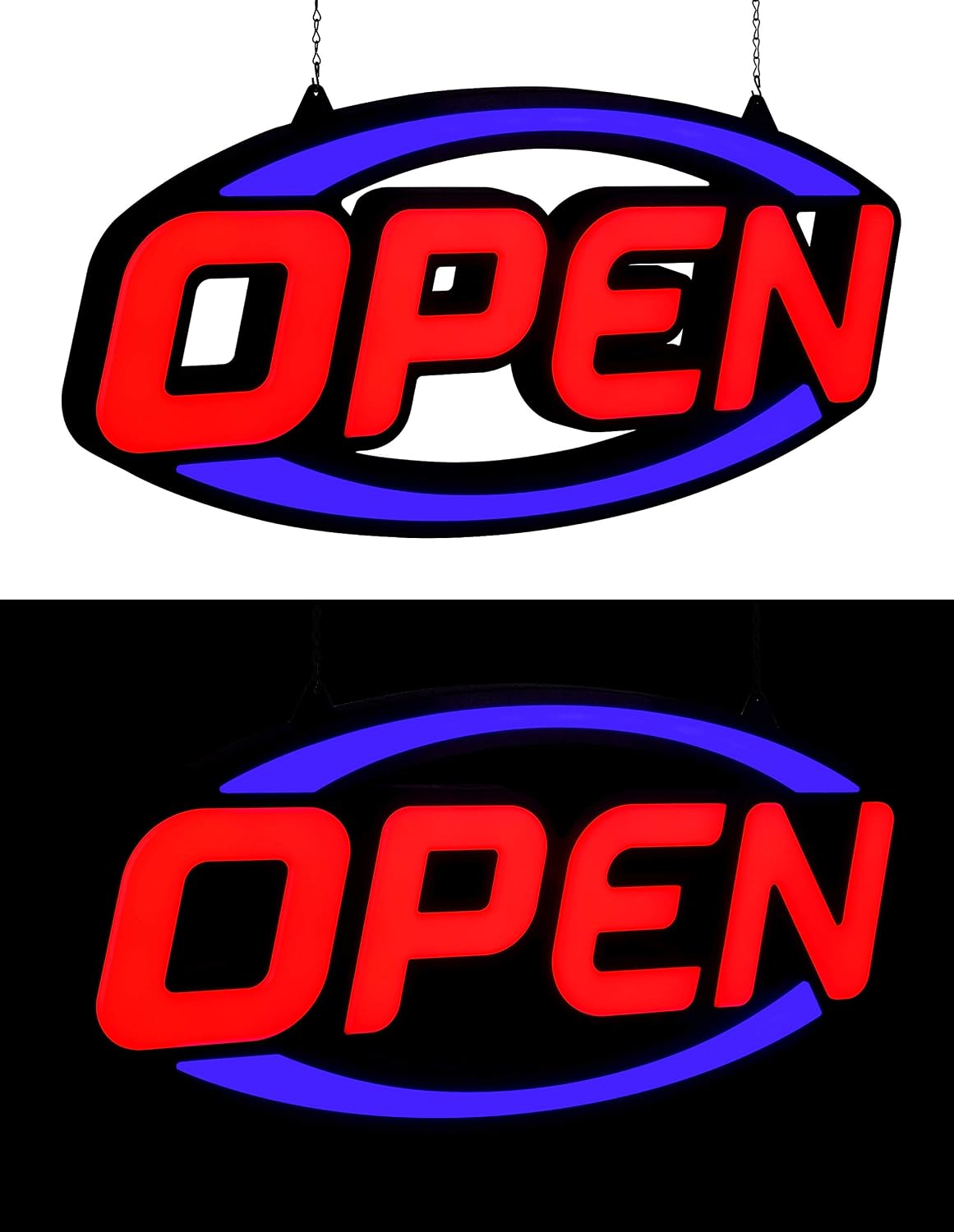
An LED open sign is exactly what it sounds like: an illuminated display — most commonly a rectangular panel or channel-letter format — that tells passing customers your business is available. The “LED” part (Light Emitting Diode) matters because it determines how bright the sign actually reads through a window, how much electricity it draws every month, and how long before the light source starts to fade. If you’ve ever walked past a storefront and barely registered whether the sign was on or off, you’ve already experienced what a low-output, poorly positioned sign costs a business in foot traffic. This guide is built for buyers who are past the “any sign will do” mindset and are now asking the harder questions: how many lumens do I actually need, does IP65 weatherproofing matter for my window installation, and which remote-dimming features will I realistically use versus which are marketing noise? Here’s what the specs actually mean — and how to use them to make a confident decision.
Brightness: Lumens, Nits, and the Window Problem
Brightness is where most spec sheets mislead buyers, because manufacturers often list a total lumen output for the sign’s LED array without accounting for the real-world condition that matters most: ambient light competition. A sign rated at 800 lumens looks striking in a dim interior at night. That same sign is nearly invisible in south-facing window glass at 2 p.m. on a sunny afternoon.
The metric that travels better across contexts is nits — a measure of luminance per square meter that accounts for the sign’s surface area, not just raw light output. Signs media.com’s reporting on LED module performance notes that effective storefront readability in daylight conditions generally requires sustained luminance above 1,500 nits; premium commercial-grade open signs from established fabricators typically spec between 2,000 and 4,000 nits for window-facing installations.
What this means for your decision:
- Window-facing, daytime-heavy traffic: Prioritize signs rated at 2,000 nits or higher. Flex-tube neon-style LED signs (the kind that mimic glass neon aesthetics) tend to run lower nit values than flat-panel LED matrix signs — a relevant tradeoff if you’re sourcing from neon fabricators who offer “open” script signs as part of their catalog.
- Interior-only or evening-primary: 800–1,200 nits is workable; you gain on energy draw and heat output.
- Double-pane or tinted glass: Tinted glass can reduce effective luminance by 30–50% depending on the film. If your storefront has architectural tinting, spec up one category from what you’d otherwise need.
The Sign Research Foundation’s research on business signage economics consistently demonstrates that on-premise signage contributes meaningfully to new customer acquisition — but the effect is dose-dependent on legibility, not mere presence. A sign that can’t be read from across the street delivers a fraction of its potential value regardless of design quality.
IP Ratings: The Number That Tells You Where the Sign Can Actually Live
IP rating stands for Ingress Protection, defined by the International Electrotechnical Commission’s IEC 60529 standard. It’s a two-digit code: the first digit covers solid particle intrusion (dust, debris), the second covers liquid intrusion (moisture, rain). A sign rated IP65, for example, is fully dust-tight (6) and protected against direct water jets from any direction (5). An IP67 sign tolerates brief submersion up to one meter.
For open signs, the relevant decision tree looks like this:
By the Numbers:
| Installation Context | Minimum Recommended IP | Notes |
|---|---|---|
| Fully indoors, climate-controlled | IP20 | Dust and splash exposure minimal |
| Window-mounted, interior side | IP44 | Condensation and cleaning spray exposure |
| Exterior-facing, covered overhang | IP65 | Wind-driven rain, temperature cycling |
| Exterior, fully exposed | IP66–IP67 | Direct precipitation, pressure washing |
Most consumer-grade LED open signs sold through general retail channels carry IP44 ratings at best — adequate for interior window mounts but not for any exterior application. Operators in long-run reviews on signage industry forums note that signs under-rated for their exposure environment show accelerated driver failure (the driver is the electronic component that converts wall current into usable LED power) within 18–24 months, well short of the 50,000-hour LED lifespan manufacturers advertise.
Underwriters Laboratories’ UL 48 standard for electric signs includes specific environmental exposure requirements for outdoor-rated products. If you’re speccing a sign for an exterior application or a high-humidity environment like a food-service kitchen visible area, confirming UL 48 listing — not just IP rating — is the professional-grade check. IP rating tells you about the enclosure; UL 48 covers the full electrical assembly.
One practical note for bar and restaurant owners: The IP rating applies to the sign housing, but your mounting hardware and conduit runs have their own exposure vulnerabilities. A well-rated sign on poorly sealed wall penetrations is still a moisture problem waiting to happen.
Remote Control and Dimming: What the Features Menu Actually Delivers
Remote control features on LED open signs have expanded significantly in the 2024–2026 product cycle. Understanding which capabilities deliver operational value versus which are specification padding will save you from paying a premium for functions your workflow won’t use.
The core feature tiers, ranked by practical utility:
1. On/Off and Brightness Dimming (IR Remote) The baseline. Infrared (IR) remotes require line-of-sight between remote and sign receiver — functional for a fixed manager’s station setup, less so for larger floor plans. Signs of the Times magazine’s 2025 LED performance overview notes that IR-controlled commercial signs remain the dominant category in the sub-$300 open sign segment, and operators report them as reliable for basic scheduling needs when staff has consistent remote access.
2. RF (Radio Frequency) Remote Dimming No line-of-sight required. Range typically 30–100 feet depending on wall construction. RF remotes are the practical upgrade for operators who control signage from a back office, point-of-sale station, or stockroom. Spec sheets for RF-enabled signs should specify operating frequency (common: 433 MHz or 2.4 GHz) and wall-penetration rating. This is the feature tier worth paying for if your sign is window-mounted facing a space where you won’t always have a clear sightline.
3. Programmable Timers Onboard timer modules let you schedule on/off cycles — useful for businesses with fixed hours that don’t want to depend on staff remembering to activate the sign. The operational ROI here is real: the Sign Research Foundation’s economics data notes that signage visibility consistency directly correlates with perceived business reliability among first-time passersby. A sign that’s reliably lit during all open hours outperforms one that’s intermittently dark because the open/close routine got skipped.
4. App and Wi-Fi/Bluetooth Control The premium tier, and the one with the widest variance in actual reliability. Manufacturer apps for LED sign control have historically lagged behind the hardware in software quality — owners across aggregated reviews in 2024–2025 report that proprietary sign-control apps frequently suffer from update discontinuation and connectivity instability when firmware versions diverge. If app control is a priority, prioritize signs that integrate with established smart-home protocols (Matter, Zigbee, or Z-Wave compatibility) rather than proprietary apps from sign manufacturers whose core competency is hardware, not software.
5. Color-Change and Animation Features Some LED open signs, particularly in the flex-tube neon style, offer RGB color-changing capability. For standard “OPEN” signage, the operational case for color-changing is narrow — consistent brand color performs better for recognition than animation novelty. Where animated/color-change signs do deliver value: seasonal promotional displays, bar environments where mood-lighting integration is part of the designed experience, and event rental inventory where versatility increases booking appeal.
The Tradeoffs You Actually Have to Make
If you’re under contract or in active spec selection, the decision usually compresses to three tradeoff pairs:
Brightness vs. Energy Cost Higher-nit signs draw more current. A 4,000-nit commercial panel typically runs 25–40W; a 1,200-nit sign might run 8–15W. At average 2026 U.S. commercial electricity rates (roughly $0.12–$0.16/kWh depending on region, per U.S. Energy Information Administration reporting), the differential across a 14-hour operational day is $15–$35 annually — not a material number for a single sign. Spec for visibility first.
IP Rating vs. Form Factor Higher IP ratings generally mean more robust enclosures — thicker gaskets, sealed conduit entries — which can affect how cleanly the sign integrates with a designed interior. For a hospitality buildout where the sign is part of an aesthetic statement (not just a utility indicator), the IP20/IP44 interior-rated sign may be the right design decision paired with intentional placement away from cleaning spray zones.
RF/Smart Control vs. Budget The jump from IR to RF remote typically adds $20–$50 to sign cost at current market pricing. The jump to app-integrated Wi-Fi control can add $80–$200 while introducing the software reliability risks noted above. If/then rule: If your operational model requires remote activation from a fixed back-of-house location, RF is worth the delta. If you’re evaluating app control purely for novelty, the current generation of sign-manufacturer software doesn’t justify the premium — revisit in 12–18 months as Matter adoption matures.
Making the Call
The practitioners who get the most out of LED open sign investments treat the purchase the way they’d treat any architectural element: spec to the actual environment, verify the certification (UL 48 for exterior), and don’t pay for smart-home features until the ecosystem supports them reliably.
Decision rules in plain terms:
- Daytime-heavy window facing a busy street: 2,000+ nits, IP44 minimum, RF remote, UL listed. Budget $150–$400 for a quality panel sign.
- Evening-primary or interior display: 800–1,200 nits, IP20, IR or RF remote is sufficient. Budget $80–$200.
- Exterior installation or food-service environment: IP65+, UL 48 outdoor listing, sealed mounting hardware. Budget $250–$600; don’t compromise on the rating.
- Event rental or hospitality buildout: Flex-tube neon-style with RGB, IP44+, RF dimming for venue control flexibility. Budget $200–$500 per unit; the versatility pays back across bookings.
The sign that reads clearly at 2 p.m. through your storefront glass and turns on reliably every morning is doing more brand work than a feature-loaded unit that’s perpetually half-visible or requires a troubleshooting session to activate. Spec the fundamentals first — brightness and protection rating — then layer in control features where your workflow actually demands them.