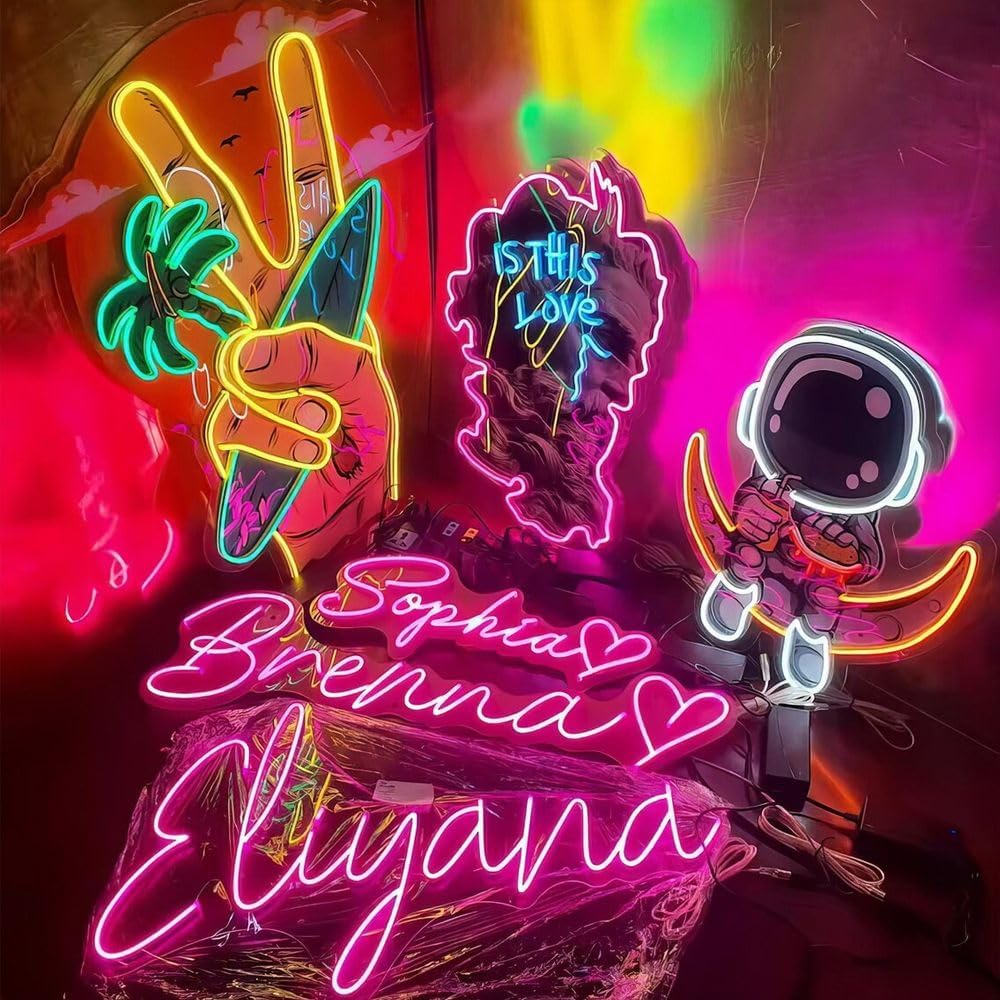
A neon sign in a hospitality space isn’t a decoration — it’s infrastructure. The difference between a sign that anchors a bar’s identity for a decade and one that flickers out eighteen months after opening almost always comes down to three things most buyers don’t ask about until it’s too late: how the transformer (the small power-supply box that converts wall current to the low-voltage DC your sign actually runs on) is rated and sized, what the sign’s IP rating (a standardized number that tells you how well the sign is sealed against moisture and dust) means for your specific environment, and whether the mounting hardware is appropriate for permanent commercial use. Get those three right, and your neon becomes a brand asset. Get them wrong, and you’re negotiating a warranty claim during your busiest Saturday night.
This guide is written for the buyer who’s already past “what is neon?” and is now spec-ing a real project — a single-location restaurant, a multi-room hotel bar, a rooftop lounge with humidity swings, or a high-volume event venue. We’ll walk the decision framework in order: transformer math first, IP ratings second, then the full permanent-installation checklist so you can hand something concrete to your fabricator or GC.
| EDITOR'S PICK[Handmade Real Glass Neon Tube B…](https://www.amazon.com/dp/B0D1WZNL52?tag=greenflower20-20) | Mid-tier[SpellBrite BAR Sign | Capture A…](https://www.amazon.com/dp/B088T1XLVY?tag=greenflower20-20) | Budget pick[Custom Business Neon Sign,LED N…](https://www.amazon.com/dp/B0CMTRWKDF?tag=greenflower20-20) | |
|---|---|---|---|
| Type | Real Glass Neon | LED Neon Look | LED Neon |
| Dimensions | 24 in | 13.4" x 6.3" | — |
| Color | — | Red | — |
| Customizable | ✗ | ✗ | ✓ |
| Suitable for | Home Bar, Pub | Bar | Studio, Office, Store |
| Price | $179.99 | $108.00 | $79.88 |
| See on Amazon → | See on Amazon → | See on Amazon → |
Transformer Longevity: The Number Every Hospitality Buyer Needs to Ask For
The transformer is the single most common failure point in a commercial neon installation, and it’s almost never discussed in the sales conversation. Here’s the practitioner frame: a sign manufacturer’s quoted “sign wattage” is the draw of the neon tube or flex element itself. The transformer must be rated at at least 20–30% above that draw to avoid running at thermal capacity — a condition that cuts transformer lifespan from a rated 50,000 hours down to under 15,000 in real-world continuous-use environments.
By the numbers:
- LED flex neon at full brightness: typically 5–12 watts per linear meter (manufacturer-rated)
- Recommended transformer headroom for commercial/continuous use: 20–30% above peak draw
- Rated transformer lifespan (quality UL-listed units, derated properly): 40,000–50,000 hours
- Continuous commercial use (18 hrs/day): ~7.6 hours of “equivalent years” per 50,000-hour rating — meaning a derated unit lasts ~6.5 years; an over-driven one can fail inside 2
Per Sign Media Canada’s transformer spec guide, the rule of thumb used by professional sign fabricators is to never size a transformer above 80% of its rated output for any installation that will run more than 12 hours daily. For a hospitality buildout — where signs often run 16–18 hours — 70% load is the safer ceiling.
When you’re evaluating fabricators, ask this directly: What is the transformer’s rated wattage, what is the sign’s peak draw, and what is the load percentage at our planned operating hours? A fabricator who can answer that question confidently is working at a different level than one who says “it comes with the sign.”
Brand comparison checkpoint: Operators in long-run reviews of Yellowpop’s commercial-tier offerings note that their transformer documentation has improved significantly since 2023, with load specs now included in the spec sheet. Voodoo Neon’s commercial quotes, per aggregated reviews from bar and restaurant buyers, typically include transformer model numbers on request. Bespoke studio fabricators vary widely — the best ones will specify a named transformer brand (Mean Well and Inventronics are the most commonly cited in commercial sign supply chains) and provide a datasheet. If your fabricator can’t name the transformer brand, that’s a red flag on a permanent installation.
One more consideration: dimmer compatibility. Most hospitality environments want the ability to shift sign brightness from full daylight service to ambient evening levels. Not all transformers support 0–10V or TRIAC dimming protocols. Confirm dimmer compatibility before fabrication — retrofitting is costly and sometimes impossible without replacing the transformer entirely.
IP Ratings Decoded for Hospitality Environments
IP ratings follow the format IP[X][Y], where the first digit (0–6) rates protection against solid particles like dust, and the second digit (0–9) rates protection against water ingress. For most sign buyers, the second digit is the one that matters operationally.
Here’s the decision matrix for common hospitality environments:
IP44 — Protected against solid objects >1mm and water splashing from any direction. Minimum viable rating for interior restaurant walls near kitchen pass-throughs or bar back-splash zones. Not sufficient for any genuine outdoor exposure.
IP65 — Fully dust-tight, protected against low-pressure water jets from any direction. The standard floor for covered outdoor installations: covered patios, roofed entryways, indoor spaces with high humidity (brewery taprooms, pool bars). This is where most quality commercial fabricators default for hospitality work.
IP67 — Fully dust-tight, protected against temporary immersion up to 1 meter for 30 minutes. Required for exposed rooftop installations, open-air terraces in high-rainfall climates, or any sign that might face pressure washing during venue cleaning. Overkill for standard interiors, but worth specifying for coastal or high-humidity markets.
IP68 — Continuous immersion rated. Relevant for underwater-adjacent installations (pool surrounds, fountain areas). Rare in neon sign applications; verify with fabricator that the flex tube and all connectors carry the rating — a sign is only as weatherproof as its weakest join point.
Per the IEC 60529 standard (the international norm that IP ratings derive from), the rating applies to the enclosure as manufactured — not after field modification. This is critical: if your installer drills a mounting hole through a sealed section of flex tubing or an IP-rated driver housing, the rating is void at that point. Specify to your fabricator and installer that all mounting penetrations must maintain the rated seal.
The real-world failure pattern: Signs of the Times magazine’s 2024 commercial LED roundup noted that the most common warranty claims from hospitality operators involved water ingress at connector points rather than at the tube itself — specifically at the junction between the flex neon element and the transformer lead. When evaluating fabricators, ask whether connector points are independently sealed to the same IP rating as the tube. The answer will tell you a lot about their commercial experience.
The Permanent Installation Checklist
This is the list I’d want in hand before signing off on a fabrication order for any permanent hospitality installation. Work through it with your fabricator, your electrician, and your GC before the sign ships — not after it arrives.
Pre-Fabrication: Spec Verification
- Transformer load percentage confirmed at your planned daily operating hours (target ≤70% for 16+ hr/day use)
- Transformer brand and model documented — request the datasheet, confirm UL listing for US installs or CE marking for EU/UK
- IP rating confirmed for both the flex tube and all connector/driver junction points, matched to your installation environment
- Dimmer compatibility confirmed — specify 0–10V, TRIAC, or PWM protocol based on your control system
- Color temperature locked in writing — for white tones especially, specify Kelvin value (warm white ≈ 2700–3000K; neutral white ≈ 4000K; cool white ≈ 5500–6500K). Architectural Digest’s 2024 feature on neon in hospitality spaces specifically flagged “warm white” as a term with no standardized meaning across fabricators — always get the K number
- Sign dimensions and weight documented — confirm your mounting surface (drywall, masonry, tile) can support the load with appropriate anchors
Pre-Installation: Site and Electrical Verification
- Dedicated circuit confirmed — commercial signs should not share a circuit with high-draw appliances; confirm with your electrician
- Transformer placement planned — transformers generate heat and need airflow clearance (typically 2–4 inches minimum); do not mount flush against insulation or inside sealed enclosures without ventilation
- Cable routing path documented — note any runs through wall cavities, conduit requirements per local code, and junction box placement
- Mounting hardware specified for surface type — masonry anchors, toggle bolts, or French cleats rated for sign weight plus a 3× safety factor per the Signs Industry Association’s commercial installation best practices
Post-Installation: Commissioning Checklist
- Full brightness burn-in completed — run at 100% for 24–48 hours post-install to identify any early transformer or tube failures before opening day
- Dimmer range verified across full scale — confirm no flicker at low end (a common symptom of dimmer/transformer protocol mismatch)
- Thermal check at 4-hour mark — transformer housing should be warm but not hot to the touch (surface temps above ~60°C / 140°F under normal load indicate an over-driven unit)
- Warranty documentation filed — photograph the installed sign and serial/model numbers; most fabricator warranties require claim initiation within 30 days of visible defect and void without proof of professional installation
If X, Then Y: The Decision Rules
If your installation runs 16+ hours daily (bar, restaurant, hotel lobby), specify transformer load at ≤70% of rated output and request a named transformer brand with a datasheet. Don’t accept “it comes with the sign” as an answer.
If your space has any moisture exposure — bar splash zones, covered patios, coastal climates — require IP65 at minimum for the full sign assembly including connectors. Upgrade to IP67 for any genuinely exposed outdoor surface.
If you need dimming, confirm the dimming protocol before fabrication. A mismatch between a PWM-only transformer and a TRIAC dimmer system results in flicker or no dimmer response — and it’s a transformer swap to fix, not a settings adjustment.
If you’re sourcing from a production fabricator (Yellowpop, Voodoo Neon, Neon Mfg) rather than a bespoke studio, budget for a documented spec sheet review before order — these brands have improved their commercial documentation, but default consumer-tier specs may not match hospitality-duty requirements. Push for the commercial-tier product line explicitly.
If your project runs above $2,000 and involves permanent mounting, treat transformer documentation and IP certification the same way you’d treat a contractor’s license — it’s not optional paperwork, it’s the thing that determines whether your asset holds its value or becomes a liability.
The sign on your wall is going to be in ten thousand guest photos. The transformer nobody sees is what keeps it lit for all of them.