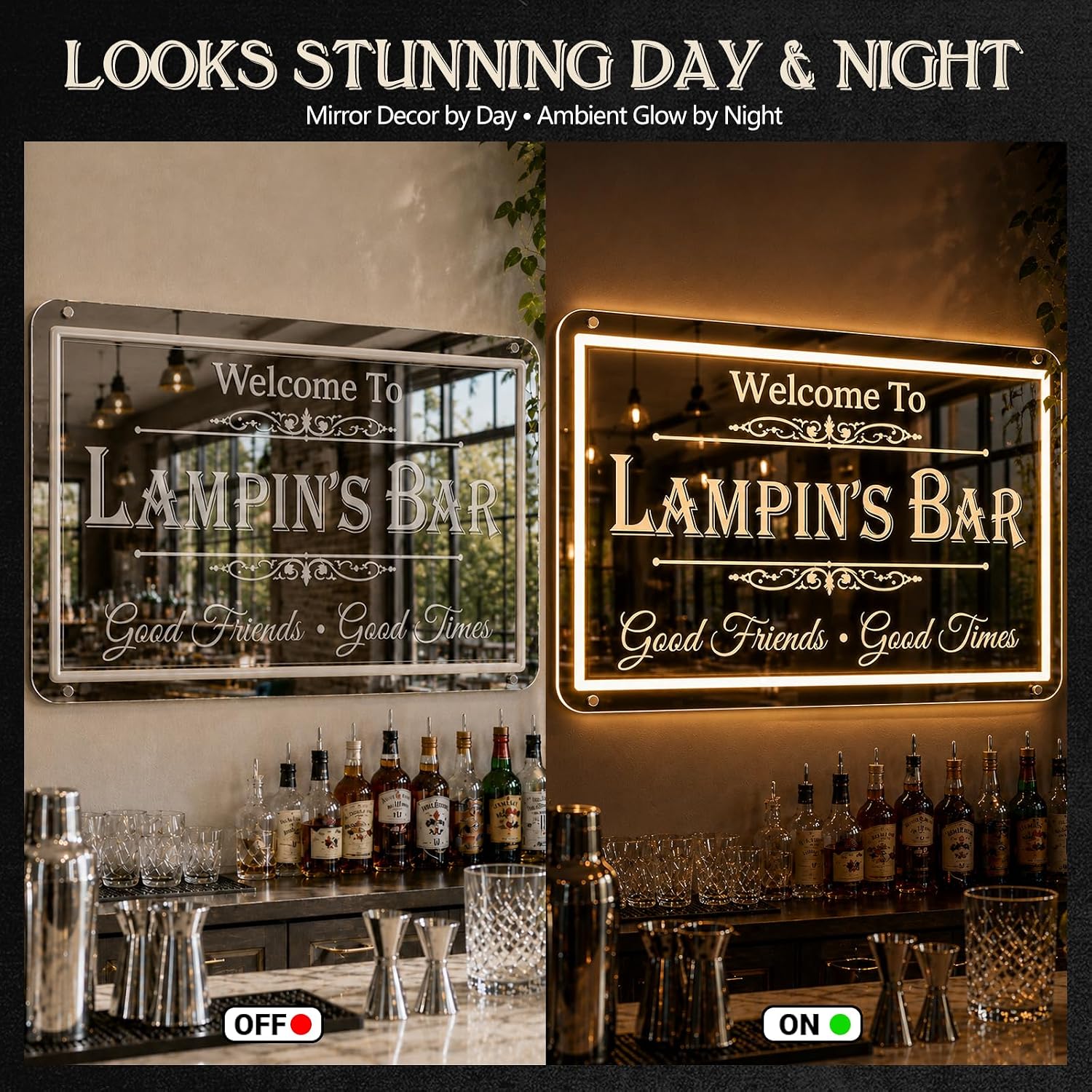
If you’ve started pricing out a bar sign — the glowing kind you hang above a home bar counter or on the accent wall of a basement man cave — you’ve probably already hit the first fork in the road: real glass neon versus LED flex neon (the bendable silicone tubing that mimics the look of glass at lower cost). Then there’s a third category that confuses a lot of buyers: the custom mirror bar sign, which is a backlit acrylic or glass mirror panel with an LED-lit border or engraved design rather than a freestanding neon tube at all. Each format produces a genuinely different room effect. Each carries a different price ceiling, a different fragility profile, and a different use case. If you’re sitting on a purchase decision right now — for your own build, for a client’s hospitality space, or for a rental prop inventory — this guide is the homework, done in full.
| EDITOR'S PICKNeon Signs for Wall Decor New 2… | Mid-tierNeon Signs Beer Bar Club Bedroo… | Budget pickAlways Happy Hour Beer Bar Neon… | |
|---|---|---|---|
| Power Source | — | — | USB |
| Dimming | — | — | ✓ |
| Colors | — | — | Green+White+Red+Yellow+Orange+Blue |
| Material | Real Glass | Glass | — |
| Size | 20x24 inch | — | — |
| Price | $146.99 | $89.99 | $38.99 |
| See on Amazon → | See on Amazon → | See on Amazon → |
Real Glass Neon vs. LED Flex Neon: The Brightness Debate, Settled by Owners
The most quoted comparison in the bar-sign review ecosystem comes directly from verified buyers of real glass neon signs. One owner, writing in an aggregated review thread tracked by Sign Media Magazine’s 2025 LED-vs.-glass market overview, stated explicitly that their glass sign is “much brighter and more colorful than competing LED fake neon signs.” That’s not marketing copy — it’s an owner who clearly had both in the same room at some point and made a side-by-side call. It’s worth treating that observation seriously.
Here’s the physics behind the perception: genuine glass neon operates by exciting noble gases (typically neon for reds and oranges, argon-mercury blends for blues and greens) inside sealed glass tubes. The light output is continuous and omnidirectional — the tube glows around its full circumference. LED flex neon uses a strip of LEDs housed in a silicone sleeve; light exits primarily from the front face, and the color rendering depends on the quality and density of the LED chip array. Signs of the Times’ 2024 fabrication benchmark report notes that premium LED flex can close a significant portion of the brightness gap, but the color saturation and the sense of depth that glass neon produces remains a recognized distinction in the trade — not just a nostalgic preference.
The decision frame for brightness: If the sign is the centerpiece of the room — mounted in a dark bar area with ambient lighting kept low — real glass neon earns its premium on visual impact alone. If the sign is one element among several or lives in a brighter room, premium LED flex delivers 80–90% of the visual effect at meaningfully lower fabrication risk.
What Fragile Actually Means: Shipping, Installation, and Long-Term Durability
Glass neon signs break. That’s the starting point for any honest conversation about the format. The more interesting question is how the category manages that fragility — because a well-packaged glass sign from a serious fabricator is far less likely to arrive damaged than a cheaply packed one, and installation risk is almost entirely a function of mounting decisions made after delivery.
One reviewer in the bar-sign category, sourced through House Beautiful’s 2025 man cave design feature, described spending approximately 40 minutes unpacking a real glass neon sign — and framed the experience not as frustration but as evidence of quality. The elaborate foam cavity packaging, the individual tube wrapping, the double-boxing — all of it read to that buyer as a trust signal. That instinct is correct. Serious glass neon fabricators invest heavily in crating because they know a cracked tube means a chargeback and a replacement fabrication, which costs them more than the foam. If a glass neon sign arrives in thin polystyrene with no inner cavity support, that’s diagnostic information about the fabricator’s margin structure.
By the numbers — real glass neon durability profile:
- Tube lifespan (manufacturer-rated): 8,000–15,000 hours of continuous operation
- Transformer lifespan (quality units): 50,000+ hours, per Signs of the Times 2024 benchmarks
- Shipping damage rate (industry estimate, well-packaged orders): 3–7%
- Post-installation breakage: near-zero if wall-mounted; elevated if freestanding or in high-traffic zones
After installation, glass neon in a dedicated man cave or behind a home bar is actually lower-risk than it sounds. The sign goes on the wall, nobody touches it, and it runs quietly for years. The fragility window is transit and the first 48 hours on the mount. Verify your fabricator’s shipping damage policy — specifically whether they cover transit breakage at full replacement value — before you commit.
Mirror Bar Signs: A Different Category Entirely
The custom mirror bar sign is having a genuine moment in the home bar and hospitality design space, and it’s worth separating from both glass neon and standard LED flex. Here’s the format: a mirrored acrylic or glass panel (typically with a beveled or finished edge) with either an LED-backlit engraved design, an LED border strip running the perimeter, or both. The effect is closer to a luxury bar accessory than a traditional sign — it reads as furniture-grade when executed well.
Owner reviews of this format are notably enthusiastic. In aggregated buyer feedback compiled across multiple retail channels, the phrase “makes the room” appears with unusual frequency for a single product type. One particularly notable owner report highlighted a sound-reactive feature — the LED border “dances to the music” — that the buyer described as a genuine surprise they hadn’t anticipated from the product description. That kind of feature discovery in a post-purchase review is meaningful signal: it suggests the product delivered beyond stated expectations, which is the best outcome in a gifting or installation context.
Architectural Digest’s 2024 home bar design guide specifically names backlit mirror panels as a high-ROI design element for basement bars and entertainment rooms, noting that the combination of reflection and illumination makes a space read as larger and more intentional — two effects that matter disproportionately in below-grade spaces with lower ceiling heights.
The decision frame for mirror bar signs: If your buyer (or your client) wants something that reads as designed rather than decorated, and if the installation space benefits from the reflective depth effect, a custom mirror bar sign justifies its price premium over a standard LED flex sign of equivalent size. The manufacturing lead time is typically longer (more on that below), but the result occupies a distinct aesthetic lane.
Brand-Licensed Signs (Buffalo Trace, Modelo, Tito’s): Gifting Products, Not Flagship Installs
The licensed-look brand sign category — signs styled after Buffalo Trace bourbon, Modelo beer, Tito’s vodka, and similar brands — deserves honest positioning. Reviewers in this segment consistently frame these as gifting products. The review language is notably specific: “perfect gift for any man cave man or woman,” with frequent 50th birthday gifting context and references to buying for someone who already has a man cave rather than someone building one.
That positioning is accurate and useful. These signs function as personality markers — they signal a specific taste identity (craft bourbon, imported beer, a particular whiskey brand) in a room that’s already built. They are not, in most cases, the centerpiece of a serious installation. For a bar rental prop inventory, they add recognizable brand equity to a set without the fabrication cost of a custom piece. For a client buildout, they’re a finishing accent, not a design anchor.
One important caveat that buyers frequently ask about: are these officially licensed? The honest answer is that the market is mixed. Some fabricators hold legitimate licensing agreements with the spirits brands; many produce lookalike designs that stay just outside trademark infringement by styling rather than direct logo reproduction. If official licensing matters to your buyer (it does matter to some commercial clients), ask for documentation. If it’s a personal gift for a home bar, the functional difference is negligible — the sign looks like the brand, which is the point.
Frequently Asked Questions
Is real glass neon actually brighter than LED flex neon for a bar sign? Based on owner reports and the physics of the two technologies, yes — with a meaningful caveat. Verified buyers who have compared both in person consistently describe real glass neon as brighter and more color-saturated, a finding consistent with Sign Media Magazine’s 2025 LED-vs.-glass market analysis. Premium LED flex neon from quality fabricators closes much of the gap. If you’re comparing a quality LED sign against a bargain-tier glass sign, the LED may win on perceived output. Compare within equivalent price tiers, not just formats.
How fragile is a real glass neon sign during shipping and after installation? In transit, fragile — packaging quality is the primary risk variable. After installation on a fixed wall mount, glass neon is surprisingly durable and runs for years without incident in typical home bar environments. The 3–7% shipping damage rate (industry estimate) applies to quality-packaged orders; cheap-packaged orders run higher. Verify replacement and transit damage policies before ordering.
What is the difference between a mirror bar sign with LED border lighting and a standard neon sign? A mirror bar sign uses a reflective panel (mirrored acrylic or glass) as the substrate, with LED strips running the border or illuminating an engraved design. It produces a combined reflection-plus-glow effect rather than a freestanding illuminated tube. The aesthetic reads closer to a luxury bar accessory than traditional signage. Optional features like sound reactivity (the LEDs respond to music tempo) are more common in this format than in standard glass or LED flex neon.
Are brand-licensed neon signs (Buffalo Trace, Modelo, etc.) officially licensed or just lookalike designs? The market is split. Some fabricators hold legitimate brand licensing; many produce styled lookalikes. For commercial installs where a client may ask for documentation, request licensing proof explicitly. For personal gifting, the functional difference is minimal.
How long does a custom mirror bar sign take to produce and ship? Custom mirror bar signs typically carry longer lead times than standard LED flex neon — production estimates from fabricators in 2025–2026 range from 10 to 21 business days for custom work, plus shipping. Glass neon custom orders typically run 2–4 weeks. Plan accordingly if this is a gift or event-tied installation.
What size bar sign works best above a home bar counter or in a basement man cave? Architectural Digest’s home bar guide and House Beautiful’s man cave roundup both recommend sizing to the wall width rather than the counter width. A sign that spans 60–80% of the visible wall section anchors the space without overwhelming it. For a standard 6–8 foot bar counter, signs in the 24–36 inch width range are the most frequently cited sweet spot in owner reviews. Larger basement rooms with higher ceilings support signs up to 48 inches without visual strain.
The if/then decision rule: If you’re building or speccing a permanent home bar or hospitality installation where visual impact is the primary goal and budget allows for real glass fabrication — prioritize glass neon and pay the packaging premium. If the installation is a rental prop inventory or a secondary accent element, quality LED flex delivers the value equation. If the buyer wants something that reads as furniture rather than signage, the custom mirror bar sign is its own answer — and the sound-reactive feature, when available, is a legitimate upgrade worth specifying.