If you’ve ever stood in front of a sign supplier’s catalog trying to decide between a changeable letter board and a fully custom neon sign, you already know the two formats feel completely different — but it’s harder to articulate why one fits your project better than the other. A changeable letter sign (also called a lightbox or marquee letter board) is exactly what it sounds like: a backlit panel or frame that holds individual plug-in or clip-in letters you rearrange by hand, so the message can be updated any time. A fixed custom neon sign is a single, permanently formed light sculpture — either real glass tubing bent to shape, or flexible LED strips formed into a custom design and set on an acrylic backing — where the message never changes. Both glow, both attract attention, and both photograph beautifully. The difference is in what you’re buying the sign to do, and that’s exactly what this article unpacks. If you have a decision pending — a bar buildout, a wedding rental inventory order, a retail window — read on.
The Core Tradeoff: Flexibility vs. Brand Signal
Here’s the decision frame that clarifies almost every purchase at this intersection: changeable letter signs sell flexibility; fixed neon signs sell identity.
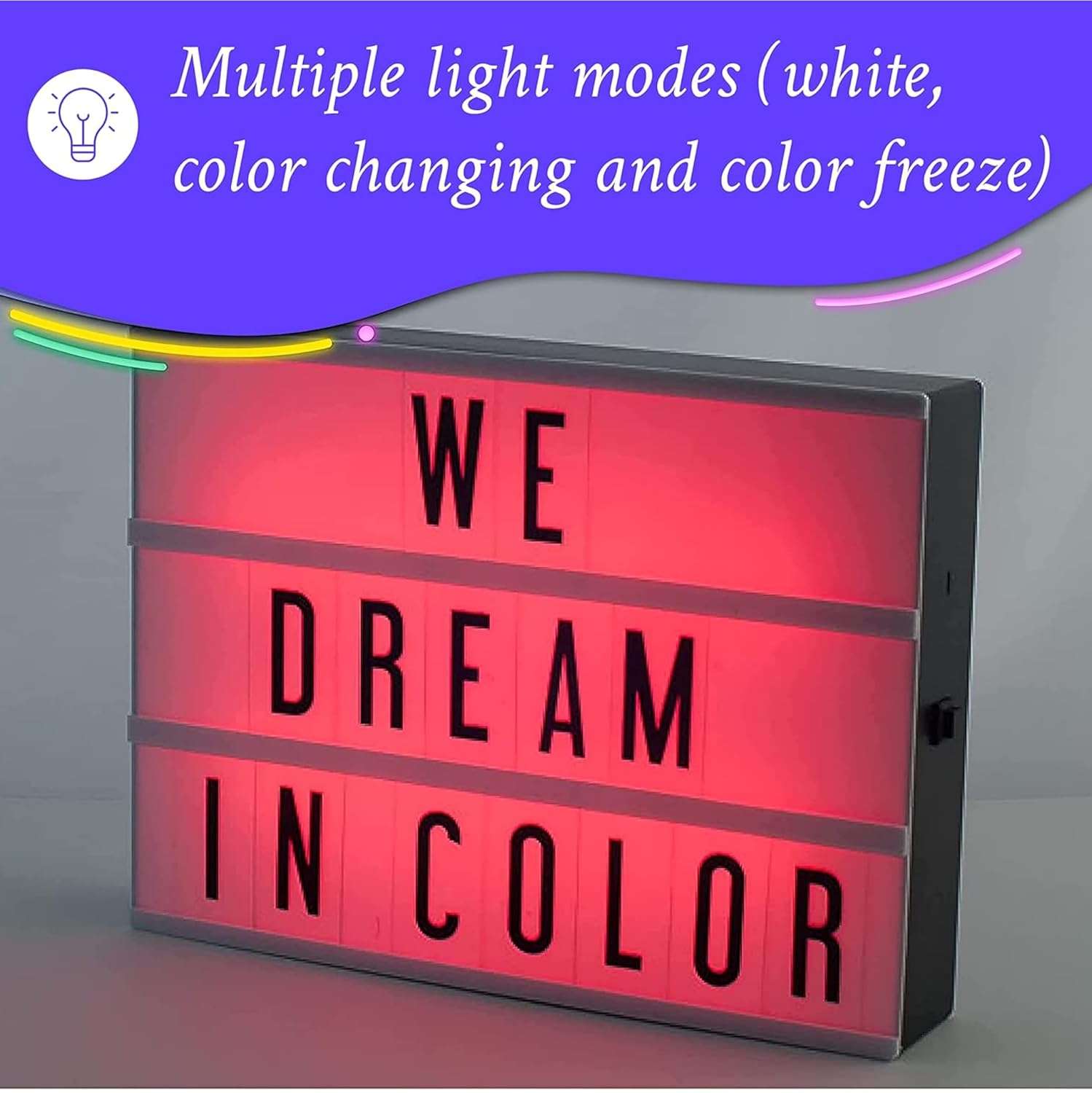
When a buyer chooses a Cinema Lightbox — one of the most-reviewed products in the changeable-letter category — what they’re paying for is the ability to type a new message tomorrow. A yoga studio announces the week’s schedule. An event rental company spells out the couple’s names for Friday’s wedding, resets for Saturday’s corporate party, and reconfigures again for Sunday’s birthday. That reuse model is the entire value proposition. Architectural Digest, in its feature “How Neon Signs Became the Defining Decor of the Decade,” notes that message-flexible displays have become standard in boutique environments precisely because they let operators respond to the week’s mood without reprinting anything.
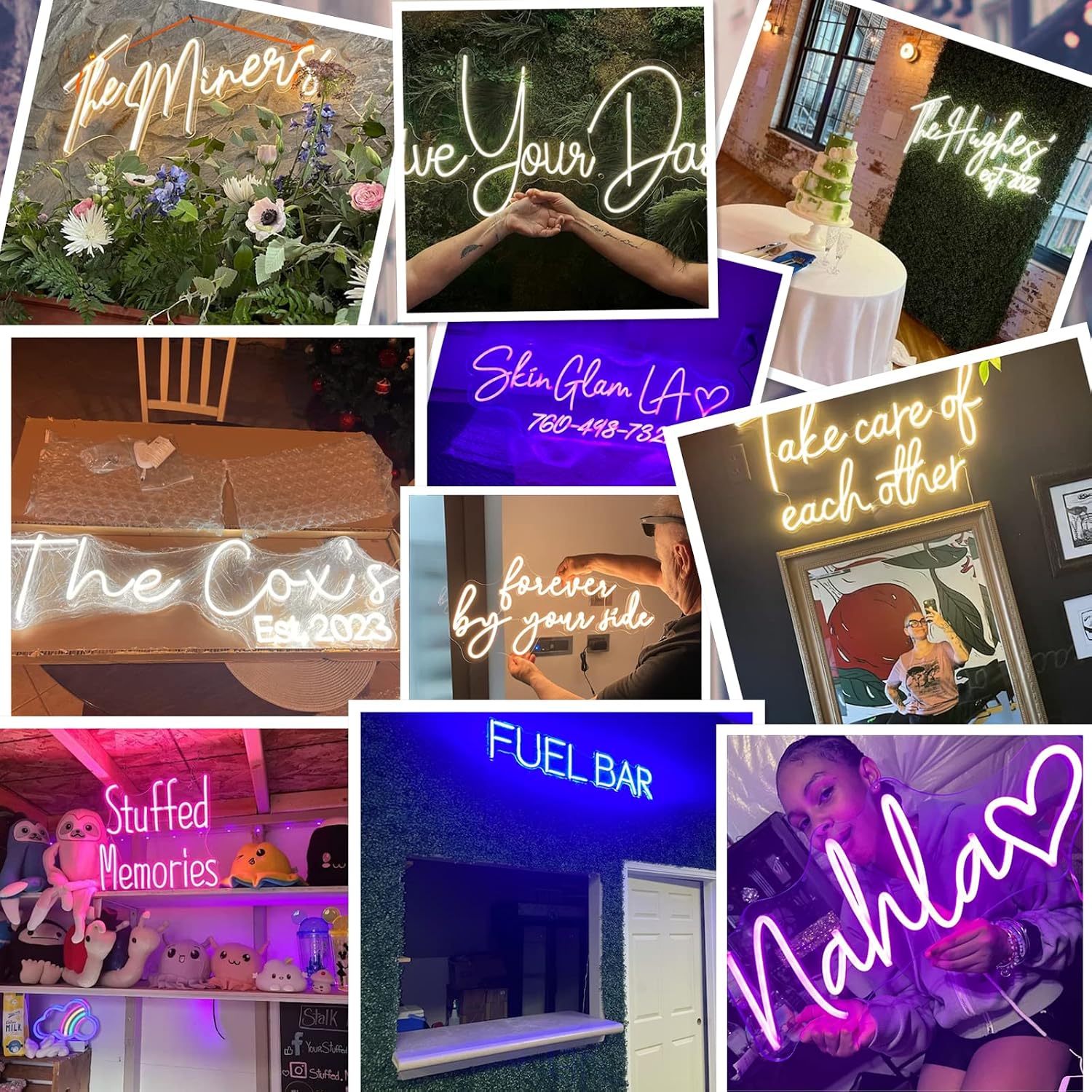
Fixed custom neon works from the opposite logic. The spray tanning studio owner who commissioned a custom sign and described the effect as going “from basic to boutique in five seconds” wasn’t describing a product she planned to update — she was describing a brand asset that tells every walk-in client something about the quality of the experience before a word is spoken. That social-proof function — guests photographing the sign, asking where it came from, sharing it organically — is something a rearrangeable letter board structurally cannot replicate, because the magic of a custom neon sign is its specificity. It says your name, your tagline, your logo glyph, in a color that matches your brand palette. It is irreversibly yours. The Knot, in its editorial coverage titled “Wedding Signage Trends: What Couples Are Ordering Now,” consistently identifies custom neon as the format that generates the most post-event organic reach, precisely because a sign that reads “Sarah & James Forever” in warm white neon photographs as a finished design object, not a generic prop.
The tradeoff is real and worth naming plainly: a changeable letter board will serve you better if message flexibility is core to your operating model; a fixed neon sign will serve you better if brand differentiation and social-proof permanence are the goal.
Product-Specific Patterns: What Buyers Are Actually Reporting
Cinema Lightbox: The Letter Inventory Problem
The Cinema Lightbox is, by aggregated reviewer consensus, one of the cleaner executions of the cinema-marquee aesthetic — warm backlight, flush letter fit, good glow diffusion. But there is one recurring friction point that shows up consistently enough across long-run reviews to qualify as a genuine purchase consideration, not a minor gripe: letter inventory imbalance.
Messages in the real world are not evenly distributed across the alphabet. The letter E, for example, appears in English text roughly five times more often than the letter Q. The Cinema Lightbox ships with a fixed letter set, and buyers who use it heavily — event rental operators running five or six installs per weekend — consistently report running short on high-frequency letters (E, A, R, S, T) while accumulating surplus low-frequency letters. Sign Media Canada, in its buyer guidance document “LED Sign Technology Trends 2025,” identifies this as a known category-wide issue, not a brand-specific defect: most consumer-tier changeable letter systems are packaged for single-message display, not high-rotation professional use.
The practical implication: if you’re buying Cinema Lightbox for a high-rotation rental or event operation, budget for a second unit at purchase, not as an afterthought. The extra letter set is not a cosmetic upgrade — it’s an operational requirement.
My
$21.99
In stock on Amazon
Check price on AmazonSpellBrite: Assembly Time as a Real Upfront Cost
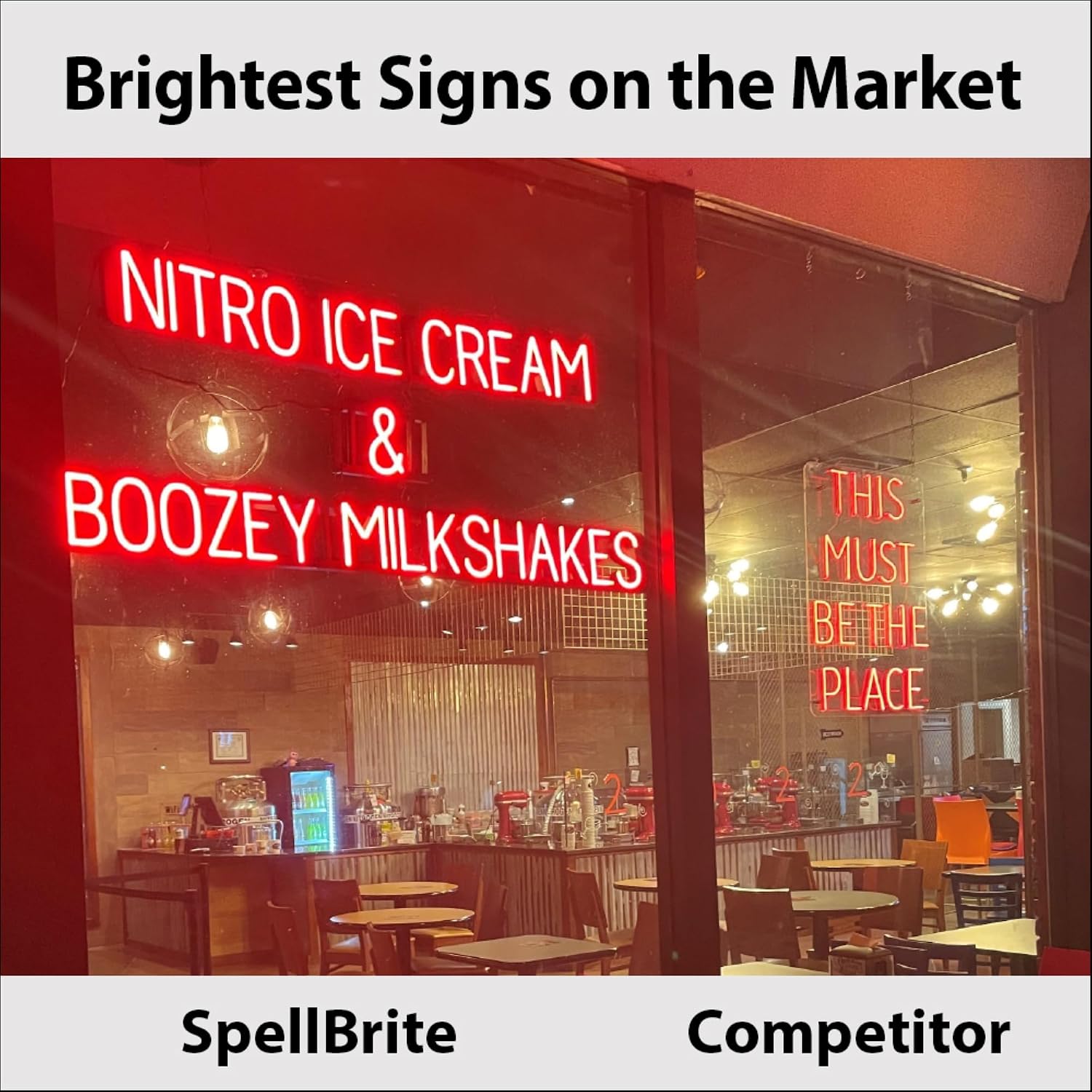
SpellBrite takes a different design approach — individual illuminated letters that hang or mount independently rather than sitting inside a framed panel — which produces a look reviewers consistently describe as closer to neon than a traditional lightbox. That aesthetic proximity to neon is a genuine product differentiator, and buyers who explicitly make the neon comparison in reviews (a recurring pattern across aggregated feedback) tend to rate their satisfaction highly.
The tradeoff SpellBrite buyers flag is assembly time. Each letter is a discrete unit that needs to be connected and arranged. For a one-time installation — a home office wall, a nursery, a permanent bar installation — that upfront assembly cost is paid once and done. For event rental operators who reconfigure frequently, that same assembly requirement becomes a per-event labor cost. Rental operators running SpellBrite at scale report that setup for a full-message display runs meaningfully longer than repositioning letters in a Cinema Lightbox frame. Apartment Therapy, in its editorial piece “The Case for a Statement Neon Sign in Every Room,” treats SpellBrite’s modular approach as an advantage for personalization and interior customization; operators pricing rental labor would weigh the same characteristic differently.
Yatvro
$24.99
In stock on Amazon
Check price on AmazonFixed Custom Neon: Where the Social Proof Is Concentrated
Across the full landscape of sign buyer reviews, the most intense social-proof language — guests photographing signs, signs “stopping people in their tracks,” clients asking for the fabricator’s contact — clusters overwhelmingly around fixed custom neon signs, not changeable letter products. This isn’t a quality judgment against letter boards; it reflects a structural reality. A custom neon sign is a designed object with visual closure. It has a specific silhouette, a specific color temperature, a specific glow quality. It reads as intentional in a way that a changeable letter board — however well-executed — does not, because the letter board is by design a generic format filled with specific content.
For bar and restaurant owners, interior designers, and event operators building premium prop inventory, that distinction has real business weight. ST Media Group’s Signs of the Times, in its “Changeable Letter Display Buyer’s Guide,” frames fixed illuminated signage as a brand-differentiation tool rather than merely a lighting fixture — a distinction that carries direct implications for how each format should be evaluated at purchase. The investment math reflects this: a quality custom LED neon sign in the $400–$1,200 range is typically amortized across years of brand use, while a changeable letter board at $80–$350 is often evaluated on a shorter payback window tied to event volume.
SpellBrite
$192.00
In stock on Amazon
Check price on AmazonFormat Comparison at a Glance
The table below maps each format against the variables that matter most to commercial buyers and event operators. Use it as a quick-reference after reading the full product sections above.
| Format | Typical Price Range | Message Flexibility | Social-Proof Signal | Best Rotation Use |
|---|---|---|---|---|
| Cinema Lightbox | $80–$200 | High (manual reset) | Moderate | 1–3 installs/week |
| SpellBrite modular | $100–$350 | High (modular reset) | Moderate–High | Permanent or low-rotation |
| Fixed custom LED neon | $200–$1,200+ | None | Very High | Permanent installation |
| Fixed custom glass neon | $600–$3,000+ | None | Highest | Permanent / prestige build |
Price ranges reflect mid-2026 retail market conditions across major fabricators and consumer platforms.
The Decision Rule
If you’ve read this far with a specific project in mind, here’s the if/then framework:
If your core use case is message rotation — event rentals, weekly specials boards, classroom or studio announcements — buy a changeable letter product and buy enough letter inventory for your highest-frequency characters from day one. Cinema Lightbox serves the compact, framed-panel aesthetic; SpellBrite serves the closer-to-neon modular look. Neither is wrong; pick based on your reset-frequency tolerance.
If your core use case is brand identity, hospitality buildout, or premium event installation where the sign is the room’s focal point — buy fixed custom neon. The social-proof return, the design-object quality, and the long-run brand signal are not things a changeable letter board can replicate, regardless of price point. A well-specified custom LED neon sign from a reputable fabricator outperforms a changeable letter board on every metric that matters for a permanent installation.
The hybrid use case — operators who want both — is legitimate. Many event rental companies report running fixed custom neon for hero props (a permanent “cheers” or ”&” sign that anchors every gallery wall) alongside a Cinema Lightbox or SpellBrite for message-flexible supporting signage. That pairing captures both the social-proof magnet and the operational flexibility without asking either format to do what it wasn’t designed for.
Frequently Asked Questions
Can I buy extra replacement letters for the Cinema Lightbox when I run out of a specific letter? Replacement letter sets for Cinema Lightbox are available through the manufacturer and select third-party sellers, but compatibility between product generations can vary. High-rotation operators should verify letter set compatibility at purchase and order supplemental inventory before their first busy season, not after a shortage surfaces mid-event.
How long does it take to assemble a SpellBrite changeable letter sign? Assembly time depends heavily on message length and operator familiarity. Reviewers across aggregated feedback report first-time setup running 20–45 minutes for a full display; experienced operators trim that significantly. For permanent home installations the one-time investment is negligible; for frequent rental resets, factor it into your per-event labor estimate.
Is a changeable letter LED sign bright enough for a storefront window? Consumer-tier changeable letter signs — including Cinema Lightbox and SpellBrite — are designed and rated for indoor use. Daytime storefront window visibility in direct sunlight is a higher brightness threshold than these products are built to meet. For exterior or window-facing applications, a commercial-grade illuminated sign with appropriate IP (Ingress Protection) rating for moisture and a higher lumen output is the correct specification.
When does it make more sense to buy a fixed custom neon sign instead of a changeable letter board? When the sign’s job is to communicate brand identity rather than variable messaging. Fixed custom neon earns its cost through permanence, design specificity, and the social-proof return documented across hospitality and event installations. If the message will never change, the flexibility premium built into a letter board is wasted spend.
Can the Cinema Lightbox or SpellBrite be used outdoors? Neither product is rated for outdoor use. Both carry indoor-only specifications. Outdoor or semi-outdoor installations (covered patios, open-air venues) require weatherproof signage rated to at least IP65, which neither consumer-tier changeable letter product meets. Using either product outdoors risks moisture damage and voids any applicable warranty.
What is the difference between a lightbox letter sign and an LED neon sign aesthetically? A lightbox letter sign reads as modular and typographic — clean, graphic, legible. An LED neon sign reads as a continuous light sculpture: the glow wraps curves, the light has visible warmth or color temperature character, and the overall effect is closer to a hand-crafted object than a printed display. Apartment Therapy, in “The Case for a Statement Neon Sign in Every Room,” describes this as the difference between “a sign that displays a message” and “a sign that is the message.” Both are valid; the aesthetic gap is real and meaningful to design-conscious buyers.