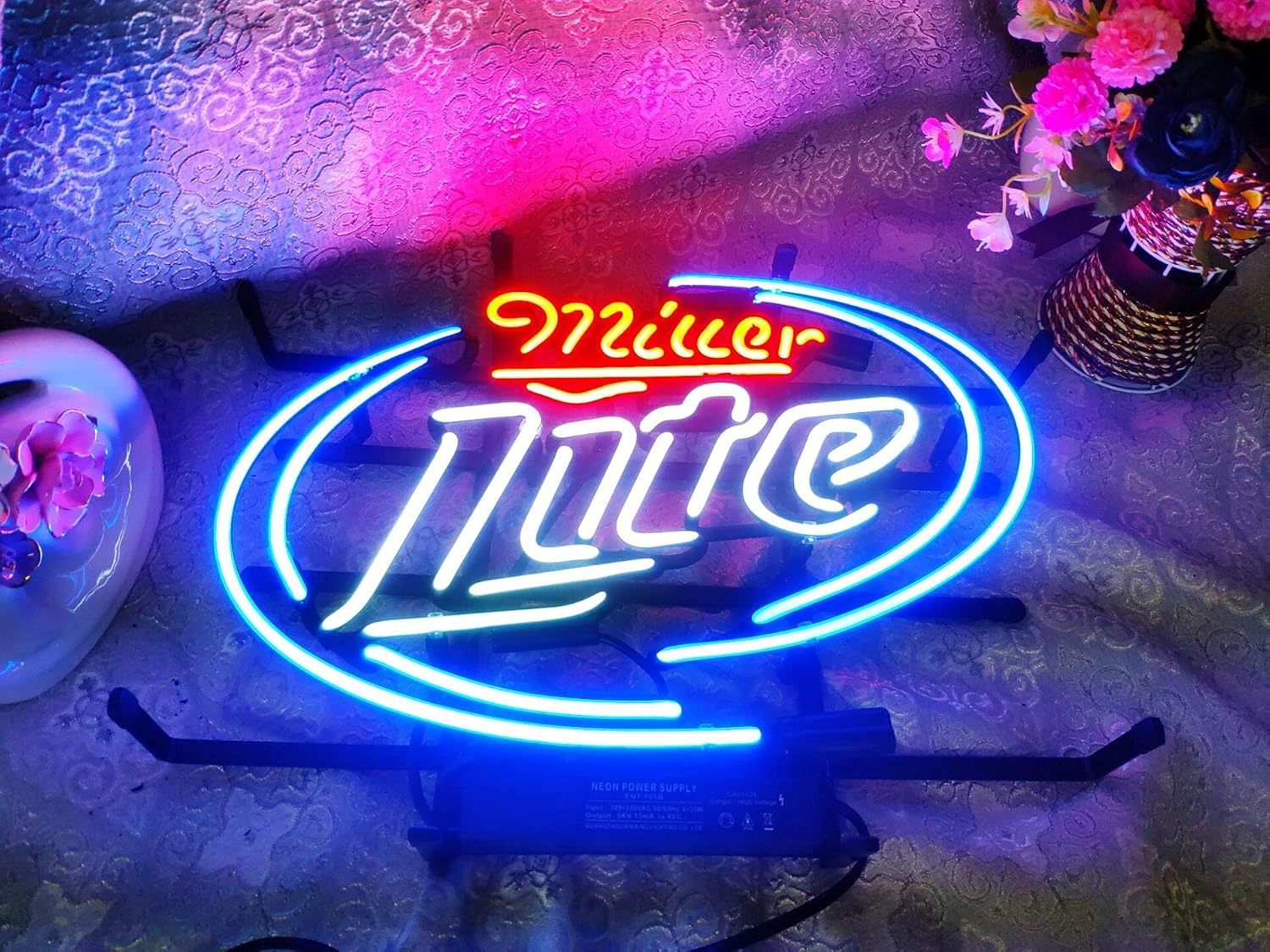
If you’ve started shopping for a custom sign — or you’re mid-spec on a client project — you’ve almost certainly encountered two options that look nearly identical in a product photo but are built on completely different technology. Real glass neon (sometimes called traditional or hot-bent neon) is exactly what it sounds like: hand-bent borosilicate or soft-lead glass tubes filled with inert gas, electrified by a high-voltage transformer to produce light. LED flex tube (also called LED neon flex, or simply “neon flex”) is a modern alternative: a soft silicone or PVC sleeve housing a strip of tiny LED chips, shaped to mimic the glow of glass. Both are legitimately called “neon signs” in the market, which creates real confusion at the spec stage. This guide cuts through that confusion. By the end, you’ll have a clear decision framework — not just a list of pros and cons, but an actual rule for which technology belongs on your particular project.
Why the Technology Difference Actually Matters
This isn’t an aesthetic argument. Both technologies can look stunning. The decision matters because glass neon and LED flex have meaningfully different operating lifespans, failure modes, maintenance profiles, and environmental tolerances — and those differences map directly to specific use cases in ways that affect your budget, your client relationships, and your long-term liability.
Let’s name the core tradeoffs plainly.
Glass neon is fragile, expensive to fabricate and repair, gloriously analog, and exceptionally long-lived when properly maintained. According to the International Sign Association’s Illuminated Sign Technology Reference Manual, traditional glass neon rated for continuous indoor operation can reach 8,000–15,000 hours of electrode life before the first re-gas or electrode replacement is needed — and the glass tube itself, if unbroken, can outlast that service interval many times over. The transformer (the component that steps household current up to the 2,000–15,000 volts the gas discharge requires) is typically the first component to fail, usually at the 5–10 year mark depending on duty cycle and load.
LED flex is durable, consistent, easier to ship, and cheaper to produce — but it carries an important asterisk on longevity. Published specs across major LED flex manufacturers rate their strips at 40,000–50,000 hours of LED chip life. That number is real — but it refers to the diode array, not the full assembly. The silicone sleeve degrades with UV exposure and heat cycling; the solder joints and driver circuits are the real failure vector in real-world operator experience. Sign Media Canada’s commercial specifier guide, “LED Flex vs. Traditional Neon: A Commercial Specifier’s Guide,” notes that in real-world hospitality installs running 12–18 hours daily, LED flex sign assemblies typically show perceptible yellowing or spot failures in the sleeve between years 4 and 7, even when the LED chips themselves are still functional.
The Numbers Side by Side
| Spec | Real Glass Neon | LED Flex Tube |
|---|---|---|
| Rated electrode/chip life | 8,000–15,000 hrs | 40,000–50,000 hrs (chips only) |
| Typical real-world install lifespan | 10–20+ years (with maintenance) | 4–8 years (full assembly) |
| Fabrication cost premium (glass vs. LED) | 2–4× at comparable size | Baseline |
| Operating voltage | 2,000–15,000V (via transformer) | 12V or 24V DC |
| IP weatherproof ratings available | IP65 (limited; sealing is harder) | IP65–IP67 (standard) |
| Shipping damage risk | High (glass) | Low |
Where Real Glass Neon Wins
Permanent Hospitality and Restaurant Installations
For a bar owner or restaurateur investing in a signature wall piece that anchors the room for a decade or more, real glass neon deserves serious consideration — not on nostalgic grounds, but on total cost of ownership. Architectural Digest’s coverage of the neon design renaissance describes the spectral quality of gas discharge light as producing a warmth that reads as depth rather than brightness — a distinction that holds up under professional photography and in-person scrutiny in ways that matter to premium hospitality operators.
The math supports it, too. At $2,000 installed for glass versus $900 for a comparable LED flex piece, you’re paying a $1,100 premium upfront. If LED flex requires a full replacement at year 6 (another $900), the glass sign has equalized by year 8 and runs ahead from there — assuming the glass sign receives periodic transformer service, which is a real ongoing cost but is typically far less than full replacement.
Bars, cocktail lounges, and restaurant dining rooms are exactly the environment glass neon was designed for. Protected indoor settings with stable temperature and humidity are what glass neon needs to reach its full lifespan. This is the use case where the premium is most defensible.
Handmade
$179.99
In stock on Amazon
Check price on AmazonLobby Statements and Retail Flagship Environments
For interior designers sourcing signage for a permanent client installation — a hotel lobby, a flagship retail entrance, a corporate reception — glass neon signals craft in a way that resonates with end clients who care about material authenticity. Dezeen’s ongoing coverage of contemporary neon craft consistently frames glass neon fabrication as a skilled trade analogous to artisan glassblowing: a human bending hot glass tube to a pattern, one section at a time, creating an object with visible handwork embedded in its form.
Some clients will ask directly whether their sign is real glass. In premium hospitality contexts especially, operators who’ve done their research can spot LED flex on close inspection — the dot pattern of the underlying LED array is sometimes visible at close range, and the light emission profile is distinctly more uniform and flatter than gas discharge. For venues where authenticity is part of the brand narrative, this distinction has real commercial weight.
Where glass neon loses the argument: outdoor exposure, event rental, and anything that ships more than once. Glass is fragile. A single hard knock during freight can shatter a tube section. For event rental companies building a prop inventory that loads into a van every weekend, glass neon is a liability, not an asset.
Handmade
$179.99
In stock on Amazon
Check price on AmazonLong-Horizon Budget Calculations
If your planning horizon is 10 years or longer, the higher upfront cost of glass neon often pencils out — but only if you’re committed to the maintenance relationship. Glass neon is not a set-it-and-forget-it technology. Transformers require periodic inspection and eventual replacement. Electrode ends darken and eventually need re-gassing by a qualified fabricator. The International Sign Association’s Illuminated Sign Technology Reference Manual treats this ongoing service relationship as a standard part of glass neon ownership, not an exceptional repair event. Clients who understand this going in — and who have access to a qualified local fabricator — are good candidates for glass. Clients who expect zero-maintenance signage are not.
Handmade
$179.99
In stock on Amazon
Check price on AmazonWhere LED Flex Wins
Event, Wedding, and Rental Installations
For event stylists building a premium prop inventory or wedding clients commissioning a statement piece for a single evening, the durability and shippability of LED flex is decisive. A glass neon sign traveling in a prop truck is a broken sign waiting to happen. LED flex signs, built on rigid or semi-rigid backing with silicone tubing, absorb handling abuse gracefully. The Knot’s vendor and event signage coverage consistently identifies LED neon as the default specification for wedding signage precisely because of logistics, not aesthetics — the sign needs to arrive intact, look great for one night, and go back in the van undamaged.
For rental operators, the economics are equally clear: a $600 LED flex prop that survives 50 rental events generates far more revenue than a $1,800 glass neon sign that breaks on event three.
Neon
$89.99
In stock on Amazon
Check price on AmazonOutdoor and Weatherproof Applications
LED flex assemblies routinely achieve IP65 or IP67 ratings. IP65 means the assembly is dust-tight and protected against water jets from any direction. IP67 adds protection against temporary immersion. Achieving equivalent weatherproofing on glass neon requires custom fabrication and sealed housings that significantly complicate installation and drive up cost. For exterior signage, storefront displays, or any installation exposed to humidity, rain, or temperature cycling, LED flex is the practical specification — the ratings and real-world performance data support it unambiguously.
Sign Media Canada’s commercial specifier guide identifies outdoor-rated LED flex as the near-universal recommendation for exterior applications in commercial buildouts, citing both the sealing advantage and the lower risk of transformer damage from moisture infiltration — a documented failure mode in improperly weatherproofed glass neon outdoor installs.
Neon
$146.99
In stock on Amazon
Check price on AmazonSmart-Home Integration and Dimmer Compatibility
Glass neon transformers are notoriously difficult to dim. Magnetic transformers in particular require specialized dimmer units, and the useful dimming range is typically narrow — often only from roughly 50% to 100% output, not a true zero-to-full range. LED flex systems operating on 12V or 24V DC with modern drivers are natively compatible with PWM dimmers, the same type used in most smart-home lighting ecosystems. For homeowners integrating a custom sign into a designed lighting scheme, or hospitality operators who want scene control, LED flex wins this comparison without qualification.
The International Sign Association’s Illuminated Sign Technology Reference Manual notes that LED flex dimming compatibility has become a standard line item in hospitality lighting RFPs as operators increasingly integrate signage into centralized scene-control systems.
Color consistency at scale is a related LED flex advantage worth naming. If you’re ordering multiple signs for a multi-location brand rollout, LED flex gives you tighter color consistency across units than glass neon, where each tube’s gas fill and electrode condition introduces minor variation. Signs of the Times — an industry trade publication distributed through the signs.org network — identifies this color-batch consistency issue as a primary reason commercial chain operators default to LED flex for branded signage programs.
Neon
$146.99
In stock on Amazon
Check price on AmazonThe Decision Rule: If X, Then Y
You’ve read the tradeoffs. Here’s the framework collapsed into a usable decision rule.
Choose real glass neon if:
- The installation is permanent (5+ year intended lifespan) in a protected indoor environment
- The client’s brand narrative includes craft, authenticity, or heritage — and they’ll be within arm’s reach of the sign regularly
- The budget supports a 2–4× fabrication premium AND an ongoing maintenance relationship with a qualified glass neon fabricator
- The venue context is hospitality or retail flagship where the spectral quality of gas discharge light is a design specification, not just a preference
Choose LED flex if:
- The sign will move, ship, or be handled more than once
- The installation is outdoors or in a high-humidity environment
- Dimmer or smart-home integration is a client requirement
- The project is event-based, rental, or has a defined 1–5 year relevance window
- Budget is under $800 and longevity-adjusted cost analysis doesn’t favor the glass premium
- Color consistency across multiple units matters (multi-location or branded rollout)
The gray zone: A permanent residential installation by a design-conscious homeowner who values authenticity but also wants smart-home dimming compatibility. Here, the honest answer is that LED flex with a quality driver and a PWM dimmer is likely the better specification. The dimming limitation of glass neon is harder to engineer around than it appears, and most residential clients won’t be examining their sign at close range for the LED dot pattern. Glass neon in this context is a valid luxury choice, not a practical requirement.
One more thing worth naming: the fabricator matters as much as the technology. A well-built LED flex sign from a studio with quality silicone tubing, robust backing hardware, and a real warranty will outlast a poorly assembled glass neon sign from a budget fabricator every time. The technology decision is the first call — but your fabricator vetting process is the second, and it’s nearly as important. Long-run operator experience consistently identifies transformer quality and backing mount construction as the failure points that separate a five-year sign from a fifteen-year one, regardless of light source.
Make the technology call first. Then vet the builder.