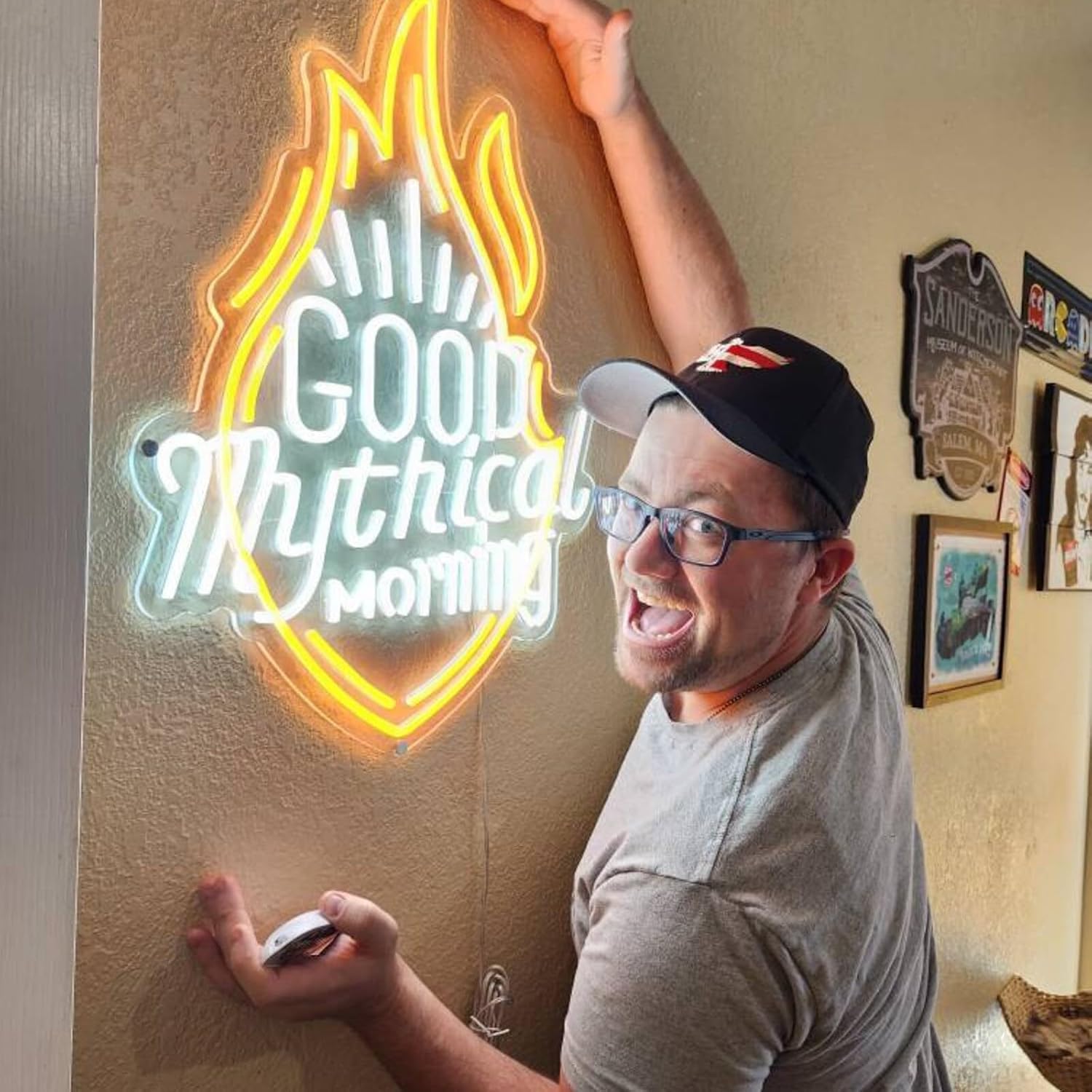
A neon sign — whether it’s built from genuine glass tubing filled with electrified gas or from modern LED flex tubing shaped to mimic that glow — is one of the fastest ways to establish a visual identity inside a salon or beauty studio. Walk past a well-lit blowout bar with a softly glowing script on the back wall, and you understand what that brand is about before anyone says a word. But the gap between a sign that builds a brand and one that quietly undermines it is wider than most studio owners realize when they’re filling out the order form. This guide breaks down exactly what drives that gap: the materials decisions, the spec choices, and the vendor questions that separate a considered installation from a $150 impulse buy that looks it.
Whether you’re outfitting a single treatment room, speccing a full salon buildout, or building a prop inventory for event rental, the framework here applies. We’ll cover materials, color accuracy, mounting, and the math that helps you decide where to put your money.
| EDITOR'S PICK[Custom Business Neon Sign,LED N…](https://www.amazon.com/dp/B0GVJFTV85?tag=greenflower20-20) | Mid-tierCustom Neon Logo Sign for Salon… | Budget pick[SELICOR Custom Logo Neon Sign -…](https://www.amazon.com/dp/B091D79MW5?tag=greenflower20-20) | |
|---|---|---|---|
| Types | Business, Studio, Office… | Salon & Business | Home, Bar, Salon… |
| Proof | — | Design proof | — |
| Color | — | Multicolor | — |
| Printing | — | — | UV |
| Price | $79.88 | $55.98 | $50.95 |
| See on Amazon → | See on Amazon → | See on Amazon → |
LED Flex vs. Glass Neon: The Decision That Sets the Budget Floor
This is the first fork in the road, and it’s worth being explicit about what you’re actually choosing between.
Genuine glass neon is hand-bent borosilicate or soft glass tubing, filled with noble gases (neon for red-orange tones, argon with mercury for blues and greens), and powered by a high-voltage transformer. It’s the original technology — warm, organic, with a glow that diffuses slightly differently than any LED can replicate. Studios that build their identity around an artisan, vintage, or high-end boutique aesthetic often find that glass neon earns its premium. Fabricators like Neon Mfg and independent glass-bending studios typically quote glass work starting around $400–$600 for a small script piece, scaling quickly past $1,500 for complex letterforms or larger formats.
LED flex neon uses a silicone or PVC sleeve housing a strip of LEDs, bent into shape and mounted on an acrylic or aluminum backing. It runs cooler, draws less power, ships more safely, and — when the tubing quality is high — looks genuinely close to glass at normal viewing distances. The quality range here is enormous. Signs of the Times magazine’s LED Flex Neon Fabrication Trends 2025 report notes that the spread between budget-tier flex tubing (thin walls, uneven LED density) and premium flex (thick silicone, tight LED pitch, consistent glow) is now large enough that they’re essentially different product categories wearing the same name. For a salon context, where clients are close to the sign and shooting it for Instagram, tube diameter and LED density matter more than they do in a bar where ambient light competes.
The practical decision rule: If your salon aesthetic is clean, modern, or Scandinavian-minimal, premium LED flex is likely the right call — it photographs cleanly, ships with lower risk, and can be dimmer-compatible out of the box. If your brand is rooted in vintage glamour, maximalist drama, or you’re building a studio where the sign itself is a hero prop clients will study up close, price out glass. The per-letter cost difference may be recoverable in brand value.
Color Temperature and Color Accuracy: Where “Warm White” Gets Complicated
Salon and beauty studio owners consistently flag color accuracy as their biggest post-installation regret — more than size, more than mounting. And that makes sense: you’re in the business of color. How the sign’s light interacts with your space, your walls, and your clients’ perception of the environment matters.
A few things to know before you finalize a color spec:
Warm white is not a standard. Across major fabricators, “warm white” LED flex runs anywhere from 2700K to 3200K (Kelvin — a measure of how yellow or blue-toned a light source reads). At 2700K, you get an amber-leaning glow that reads as intimate and vintage. At 3200K, it’s brighter and cleaner. House Beautiful’s coverage of neon sign trends in interior design consistently notes that warm-white signs photograph differently than they appear in person under daylight-balanced salon lighting — what reads as romantic in dim evening light can look washed-out or greenish under a 5000K overhead system. Request a color sample chip or a lit swatch photo from the fabricator — taken under conditions similar to your installation environment — before committing.
Blush, nude, and rose-gold tones are notoriously inconsistent. These are the most-requested colors in salon contexts, and the hardest to get right. The pink spectrum in LED flex is highly brand-dependent: Yellowpop’s “blush” and Voodoo Neon’s equivalent are visibly different in aggregated owner reviews. If color precision matters to your brand, request a Pantone reference match or ask the fabricator explicitly which LED chip SKU they’re using for that color. Premium fabricators will answer this question; budget vendors won’t.
Dimmer compatibility is not automatic. LED neon and dimmers are increasingly compatible, but only when the transformer (the power supply that converts wall current for the sign) is rated for dimming. A non-dimmable transformer on a dimmable sign circuit will flicker, hum, or fail early. Architectural Digest’s analysis of how lighting defines hospitality interiors emphasizes that dimmability is now a baseline expectation in design-forward spaces — it allows a single sign to serve ambient mood in the evening and a brighter, more active daytime environment. Confirm dimmer compatibility at the spec stage, not after the sign arrives.
By the Numbers: What a Salon Neon Sign Actually Costs in 2026
| Sign Type | Typical Size | Price Range | Notes |
|---|---|---|---|
| LED flex, single word/script | 18–24” wide | $180–$400 | Budget to mid-tier fabricators |
| LED flex, premium multi-word | 36–48” wide | $500–$900 | Thick silicone, tight LED pitch |
| Glass neon, custom script | 24–36” wide | $600–$1,400 | Hand-bent, includes transformer |
| Glass neon, complex/large | 48”+ or multi-element | $1,500–$3,000+ | Studio-quality fabricators |
Per the International Sign Association’s Custom Sign Pricing Benchmarks 2024, the cost-per-letter for custom LED neon from established vendors runs $25–$65 depending on font complexity and tube diameter. Glass neon runs $60–$120 per letter from reputable domestic fabricators.
Mounting, IP Ratings, and the Details That Age Well (or Don’t)
The sign itself is only part of the investment. How it mounts and how it holds up over time is where a lot of salon owners discover they’ve made a decision they can’t easily undo.
Mounting systems: The two standard approaches are wall-standoff mounting (hardware clips hold the acrylic backing panel off the wall, creating a shadow gap that adds depth to the glow) and flush panel mounting (the backing sits directly against the wall). For salon contexts, standoff mounting almost universally reads as more premium — it suggests intentionality. The shadow depth is typically 1–2 inches; fabricators who allow you to specify standoff height are giving you a real design variable. Cheap vendors ship a fixed standoff system or none at all.
IP ratings: IP stands for Ingress Protection — it’s a standardized rating system (IP20, IP44, IP65, IP67, etc.) that tells you how well the sign’s components resist dust and moisture. Per Sign Media Canada’s coverage of IP ratings and outdoor neon installs, IP20 is the minimum for dry indoor use; IP44 covers splash resistance for humid environments like shampoo bowls or treatment rooms with steam. If your sign is anywhere near a wash station or a steaming facial area, IP44 or higher is worth paying for. Don’t assume — ask and verify.
Transformer quality and longevity: The transformer is the component that most determines sign lifespan. In LED neon, the driver (power supply) is typically rated 30,000–50,000 hours at manufacturer spec. What separates premium fabricators is whether they publish this spec, which brand of driver they use, and whether the driver is user-replaceable. Operators in long-run reviews consistently note that signs from budget vendors fail at the driver, not the tubing — and that when the driver is potted inside a sealed housing, replacement requires returning the whole sign. Ask: “Is the power supply user-replaceable?” A fabricator confident in their product answers this immediately.
Acrylic backing quality: Clear acrylic shows the LED strip beneath the tube — less elegant up close. Frosted or black acrylic backs hide the infrastructure and make the glow read cleaner. High-end installations often use cut-to-shape backing that follows the letterform rather than rectangular panels — this is a meaningful aesthetic upgrade and a fair signal of fabricator quality.
Vendor Comparison Framework: The Questions That Separate the Field
You’re likely comparing two to four vendors right now. Here’s the decision frame that moves you past price-per-letter to a quality-adjusted comparison:
1. Can they show you a lit swatch in your color under your lighting conditions? If no, you’re buying blind on color. That’s an acceptable risk at $200; it’s not at $800+.
2. Do they publish transformer/driver brand and lifespan rating? If not, ask directly. Reputable fabricators — Yellowpop, Voodoo Neon, Neon Mfg, and most boutique studio fabricators — can answer this. A non-answer is a data point.
3. What’s their damage and warranty claim process? Shipping damage is the most common post-order problem in this category. Ask for their claim process in writing before you order. “Contact us and we’ll work it out” is not a policy.
4. What’s the LED pitch (density) in their flex tubing? Higher LED density (measured in LEDs per meter) means more even glow with fewer hot spots. Budget flex tubing often runs 60 LEDs/meter; premium tubing runs 120–240. The difference is visible in real-world photos, especially on curves and letterforms.
5. Is the sign dimmer-compatible, and with which dimmer types? Leading-edge vs. trailing-edge dimmers behave differently with LED drivers. A fabricator who can specify compatibility is doing real technical work; one who says “should be compatible with most dimmers” is guessing.
The Decision Rule
If you’re a salon owner or interior designer with a budget under $400 and a sign that will live in a dry, low-humidity space with consistent ambient lighting, a quality LED flex sign from an established mid-tier vendor is a legitimate, brand-appropriate choice — provided you’ve confirmed color via a swatch and verified IP rating for your environment.
If you’re investing $600 or more, operating in a humid or high-traffic environment, or building a brand identity where the sign is a hero element of the space, the extra spend on thicker silicone tubing, a named-brand driver, standoff mounting, and a fabricator who’ll answer your technical questions is not a luxury — it’s the difference between a prop and a statement. Operators in long-run reviews consistently report that the premium tier pays back in avoided replacement costs within 18–24 months at typical salon operating hours.
Glass neon earns its price when the aesthetic demands it. For everyone else: buy the best LED flex you can vet through the questions above, and specify your color in Kelvin or Pantone terms, not by marketing name.
The sign on your wall is the first thing a new client sees before they sit in your chair. Treat the spec decision accordingly.