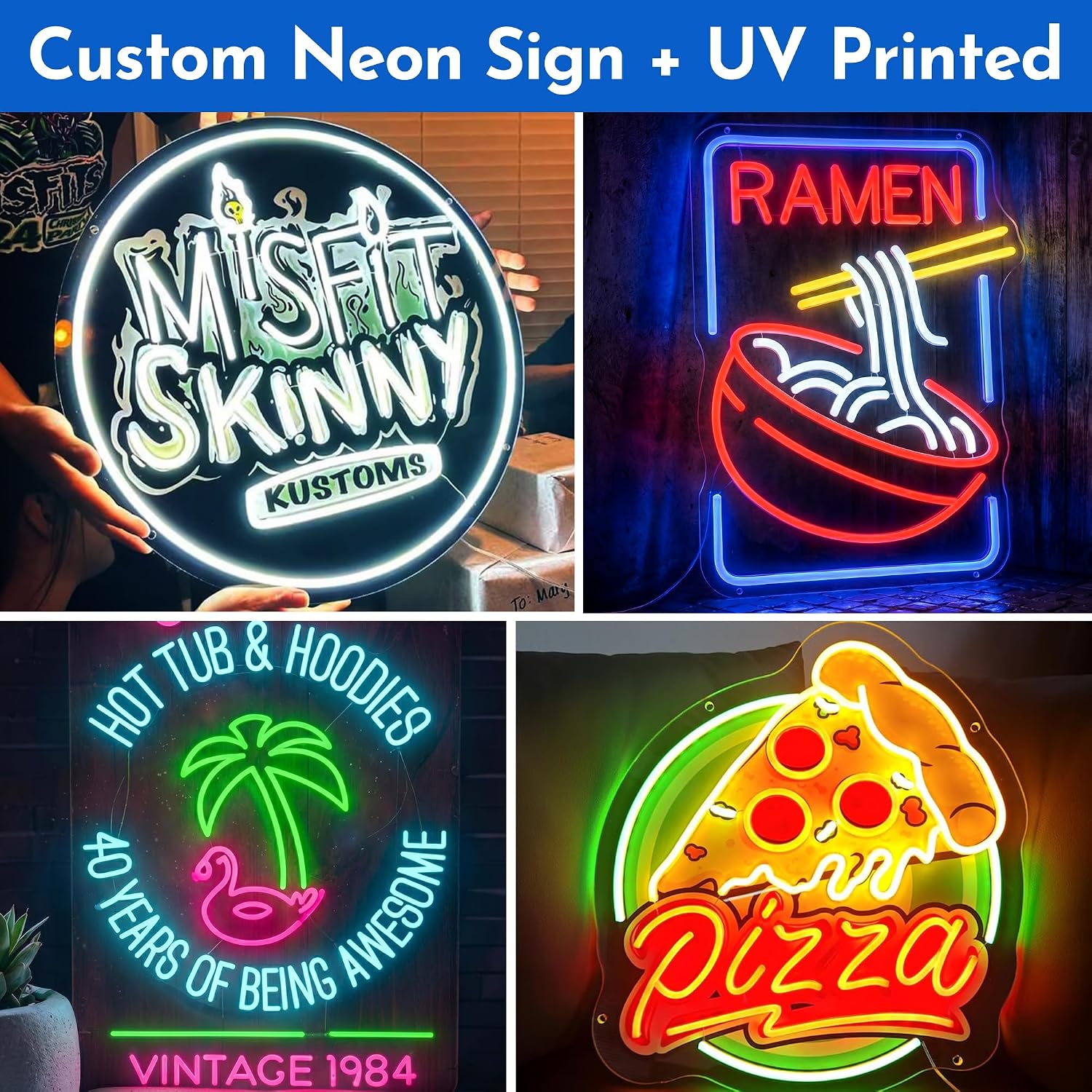
If you’ve been quoted $1,200 for a custom neon sign and the spec sheet says “UV-printed logo,” you deserve to know exactly what that means — and why it matters for your brand. UV printing, in this context, is a process where an ultraviolet flatbed printer lays ink directly onto the surface of the LED neon flex tube (the flexible, silicone-jacketed strip that holds the LED diodes and mimics the look of traditional glass neon). The result is a logo, wordmark, or graphic element embedded into the sign’s backing acrylic panel or directly onto the tube housing itself, rather than being a separate vinyl overlay. That distinction sounds subtle, but it controls whether your signature burgundy or precise Pantone orange still looks right when the sign is backlit at 2 a.m. in a dimmed hospitality space. This guide breaks down the fabricators doing it well, the specs that predict real-world color accuracy, and the decision logic for choosing between them when money and brand standards are both on the line.
Why Color Accuracy Is Harder Than It Looks on a Neon Sign
Most buyers come into this category assuming that if they supply a Pantone code or a hex value, the fabricator plugs it in and the sign comes out matching. That’s roughly true for the LED channel color — the light emitted by the diode array inside the tube. But UV-printed elements are an entirely separate layer, and they interact with that backlight in ways that can throw your color perception off by 10–40 Delta-E units depending on substrate choice, ink opacity, and how the acrylic backer is finished.
The International Sign Association’s guidance on color matching in illuminated signage (Signs.org, “Color Matching in Digital and Illuminated Signage”) draws a hard line between reflective color matching — where you’re evaluating ink under ambient light — and transmissive color matching, where light passes through or behind the printed element. A UV-printed logo panel on a neon sign is almost always a transmissive evaluation problem. Your print needs to survive backlighting, and most fabricators don’t tell you upfront whether they’ve profiled their inks for transmissive output or just reflective print standards.
Signs of the Times magazine’s 2025 LED neon flex market overview notes that fewer than 40% of mid-market fabricators run transmissive color proofs before production approval. They print, they photograph under studio lighting, they send you a proof image that looks great — and then your sign arrives and the logo reads two shades darker when unlit and visually shifts toward warm orange when the LEDs kick on. This is the single most common complaint in aggregated installer reviews of the $500–$1,500 bracket.
Three variables control whether a fabricator actually solves this:
1. Acrylic backer specification. Clear acrylic transmits backlight uniformly but can create hot-spot halos around LED channels. Frosted or opal-white acrylic diffuses the light more evenly, which smooths color rendering across the printed graphic. Premium fabricators offer both and will tell you which is appropriate for your logo’s density. If a fabricator only offers one backer option, that’s a signal their UV printing workflow wasn’t designed around logo accuracy specifically.
2. Ink layer count and UV cure profile. A single-pass UV print on flex tubing is fast and cheap. A three-pass build — white underbase, color layer, protective clearcoat — adds roughly $80–$150 to material cost on a mid-size sign but dramatically improves both color saturation and the long-term resistance of the ink to UV degradation from the LEDs themselves. Sign Media Canada’s technical breakdown of UV flatbed printing on neon flex substrates confirms that white underbase is the single most impactful variable for logo color fidelity on backlit applications.
3. LED color temperature behind the print. A “warm white” LED channel (roughly 2700–3000K) will cast a yellow bias onto any color printed above it. If your brand logo includes cool blues or neutral grays, a warm white backlight makes them read as muddy. The fabricator needs to either offer neutral white (4000–4500K) or daylight white (5500–6500K) LED options, or provide a documented offset in the proof process. Not all do.
Fabricator Comparison: What the Evidence Shows
At the time of writing (May 2026), the four fabricators most consistently appearing in commercial buyer comparisons at the $800–$3,000 project level are Yellowpop, Voodoo Neon, Neon Mfg, and custom studio fabricators (regional or direct-to-trade studios, typically found through referrals or sign industry directories). Here’s how the documented evidence stacks up on UV printing specifically.
Yellowpop has built its reputation on consumer-accessible ordering and fast turnaround, and at the lower-complexity end — text wordmarks, single-color logos — the online configurator produces consistent results. However, operators who have commissioned multi-color brand logos with tight Pantone requirements report that Yellowpop’s standard workflow doesn’t include a transmissive proof step. Aggregated reviews from hospitality installers consistently note acceptable color on simple designs but visible color shift on complex gradients or logos with both dark and light elements. Their acrylic backer is proprietary — specifications aren’t published — which makes pre-order color modeling difficult.
Voodoo Neon publishes more technical detail about their production process than most competitors, including documentation that they run color profiles calibrated for backlit output. Owners working on bar and restaurant installations note that Voodoo’s approval process includes a physical swatch step for multi-color logo projects above a certain order value, which is a meaningful differentiator. The tradeoff is lead time: the additional proofing adds 5–8 business days to production for complex logo work, which matters if you’re building out a space on a contractor schedule. Pricing at this tier runs roughly 15–25% higher than Yellowpop on equivalent sign sizes, per publicly listed rate cards as of early 2026.
Neon Mfg occupies a fabricator position closer to trade-facing than consumer-direct, and their published spec sheets for UV-printed logo work are the most detailed of any mass-market option in this comparison. They specify ink pass count, offer white underbase as a standard line item (not an upcharge), and publish LED color temperature options across their channel catalog. Interior designers and brand owners sourcing for client projects consistently cite Neon Mfg in forums and industry groups as the most reliable for brand-standard color fidelity. The tradeoff: minimum order thresholds and a quoting workflow that isn’t instant — this is a studio relationship, not a configurator click-through.
Bespoke studio fabricators vary enormously by shop, but the best of them offer something the nationals can’t: a proofing conversation. A studio that works primarily in commercial signage will typically do transmissive mockups in physical materials before committing to production, and they’ll flag the LED temperature interaction problem before you do. Dezeen’s coverage of neon signage in high-end hospitality design explicitly calls out the value of bespoke studio relationships for brand-critical installations — the article observes that the most photogenic hospitality neon you’ve seen in architectural media is almost always custom studio work, not a national platform order. The pricing premium is real: expect 30–60% above platform pricing for comparable sign dimensions, but with far more production control.
By the Numbers
| Fabricator | UV Proof Type | White Underbase Standard? | LED Temp Options | Typical Lead Time (Logo Work) |
|---|---|---|---|---|
| Yellowpop | Digital image only | Not documented | Limited | 7–10 business days |
| Voodoo Neon | Physical swatch (threshold-dependent) | On request | 3 documented | 12–18 business days |
| Neon Mfg | Published spec sheet | Yes, standard | Full catalog | 15–20 business days |
| Bespoke Studio | In-person / physical mock | Yes, typically | Specified per project | 3–6 weeks |
Lead times reflect mid-2026 production volumes based on published turnaround windows and buyer-reported timelines across industry review sources.
The Costs That Don’t Show Up in the Quote
Architectural Digest’s coverage of neon signage in high-end interiors notes something that’s easy to overlook when comparing quotes: the downstream cost of a sign that doesn’t match your brand standards isn’t the reprint — it’s the installation labor, the delay to your opening, and the brand impression made on every guest or client who sees it before it’s corrected.
For a single bar or restaurant buildout, a sign that arrives with color-shifted logo printing typically triggers one of three outcomes: the owner accepts a compromise (common, and visible to anyone who knows the original brand colors), the fabricator offers a partial reprint credit that still requires re-installation, or a full redo at significant cost. None of these is a good outcome for a sign you’re planning to photograph for your opening press.
The math that actually matters when evaluating a price gap between, say, a $900 Yellowpop order and a $1,400 Neon Mfg quote on a comparable logo sign: the $500 difference is about 35% of the base price, but it’s less than the cost of one day of a contractor’s time sitting idle waiting for a reprint, or one postponed press event. For commercial buyers, that reframe tends to close the decision quickly.
For gift-buyers or personal-use shoppers considering a UV-printed name sign in the $150–$300 range: the stakes here are lower, and the color shift issue matters less when you’re not color-matching a brand standard. At that tier, the more meaningful differentiator is the backer finish (frosted vs. clear for living space warmth) and whether the fabricator offers a dimmer-compatible driver — not the ink pass count.
If X, Then Y: The Decision Rule
If your project involves a brand logo with documented Pantone or hex standards, a hospitality opening on a fixed date, and a budget above $900: go to Neon Mfg or a bespoke studio, not a consumer platform. Require a transmissive proof before production approval. Build lead time into your contractor schedule.
If your project is a branded retail or event installation where color matching is important but not brand-critical, and speed matters: Voodoo Neon’s proofing workflow at the right order threshold is the reasonable middle path. Confirm with their sales team that your order qualifies for a physical swatch step.
If you’re building prop inventory for event rentals or speccing a sign for a space that’s photographed frequently: the LED color temperature decision matters as much as the print. Specify 4000–4500K neutral white unless the design space is deliberately warm-toned. Get that in writing on the order.
If you’re a first-time buyer buying a personal name or phrase sign and UV printing is just for a small decorative graphic element: Yellowpop’s configurator is fine at the lower complexity end. Don’t pay a studio premium for a project where color-critical brand accuracy isn’t the point.
The best UV-printed neon sign isn’t the one with the lowest price per letter — it’s the one that still looks like your brand six months after the opening photos are done.