If you’re shopping for a custom logo sign — meaning a sign built around your specific business mark, wordmark, or monogram, not a generic phrase — you’re navigating two distinct technologies that look almost nothing alike in real life. The first is an acrylic backlit sign: your logo is cut or printed onto a flat acrylic panel, and an LED light source behind it makes the design glow or “float” against the wall. The second is a UV-printed neon flex sign: a strip of flexible LED tubing is printed in full color via ultraviolet inkjet technology, so complex logos and multi-color artwork appear directly on the tube itself rather than being bent into shape. Both formats are LED-powered, both are ordered as custom pieces with a proof process, and both have landed in bars, salons, studios, and retail buildouts across the country. But they answer very different briefs. This article names the tradeoffs explicitly, shows the math, and ends with clear decision rules — because you probably have a deadline.
| EDITOR'S PICK[Custom Logo Business Neon Sign](https://www.amazon.com/dp/B0CWR6XVRG?tag=greenflower20-20) | Mid-tierCustom Neon Logo Sign for Salon… | Budget pick[SELICOR Custom Logo Neon Sign -…](https://www.amazon.com/dp/B091D79MW5?tag=greenflower20-20) | |
|---|---|---|---|
| Light Type | Backlit | Neon | Neon |
| Print Method | — | — | UV Printed |
| Mounting | Floating | Wall | Wall |
| Proof Provided | — | ✓ | — |
| Color Options | — | Multicolor | — |
| Price | $62.89 | $55.98 | $50.95 |
| See on Amazon → | See on Amazon → | See on Amazon → |
What You’re Actually Buying: Format Breakdown
Acrylic Backlit Signs
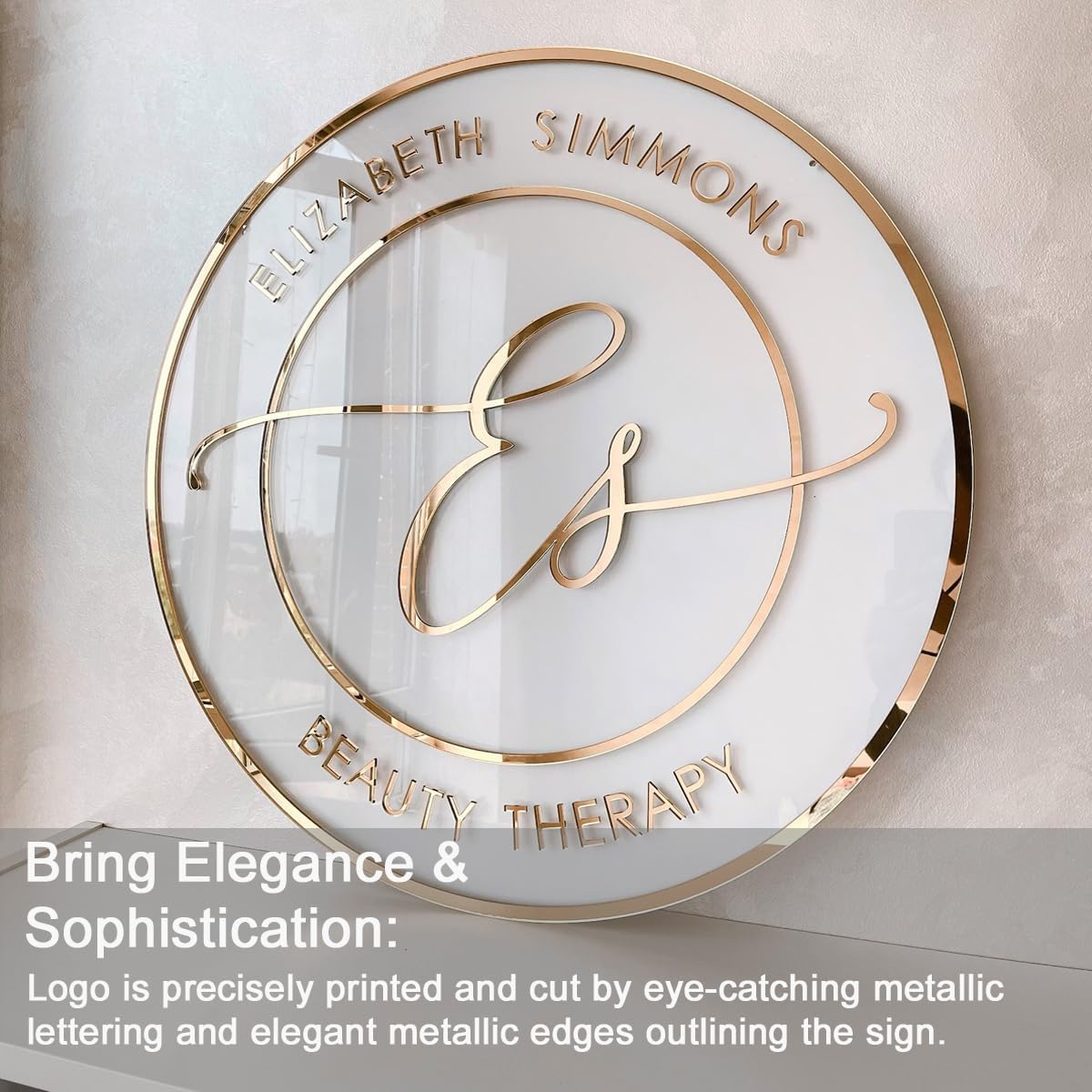
The construction is simpler than it sounds. A sheet of clear or colored acrylic — typically 3mm to 6mm thick — is either laser-cut into individual letters and shapes or printed with a UV-stable ink. LED strips or modules behind the panel project light through and around the acrylic, creating the “floating letter” effect that owners consistently describe in glowing terms. One owner specifically called out a gold background panel as looking “rich and elegant,” which tracks: the interplay between a metallic or colored backing panel and edge-lit acrylic produces a depth that photographs punch above its price class.
The visual signature is clean, architectural, and corporate-adjacent — well-suited to reception desks, retail shelving backdrops, salon feature walls, and event backdrops where the brand needs to read as polished rather than playful.
According to Sign Media Canada’s LED Signage Buyer’s Guide 2025, quality acrylic backlit panels typically run LED drivers rated at 30,000–50,000 hours, which at eight hours of daily use works out to roughly 10–17 years of driver life before replacement. That longevity math is one of the format’s strongest arguments for permanent commercial installs.
By the numbers — acrylic backlit:
- Typical custom order range: $150–$600 for small-to-mid business logos (12”–36” wide)
- Production + shipping lead time: 5–10 business days reported by multiple owners
- IP rating on most indoor units: IP20–IP44 (not weatherproof without a custom spec)
- Common transformer: 12V DC, plug-in wall adapter included in most kits
UV-Printed Neon Flex Signs
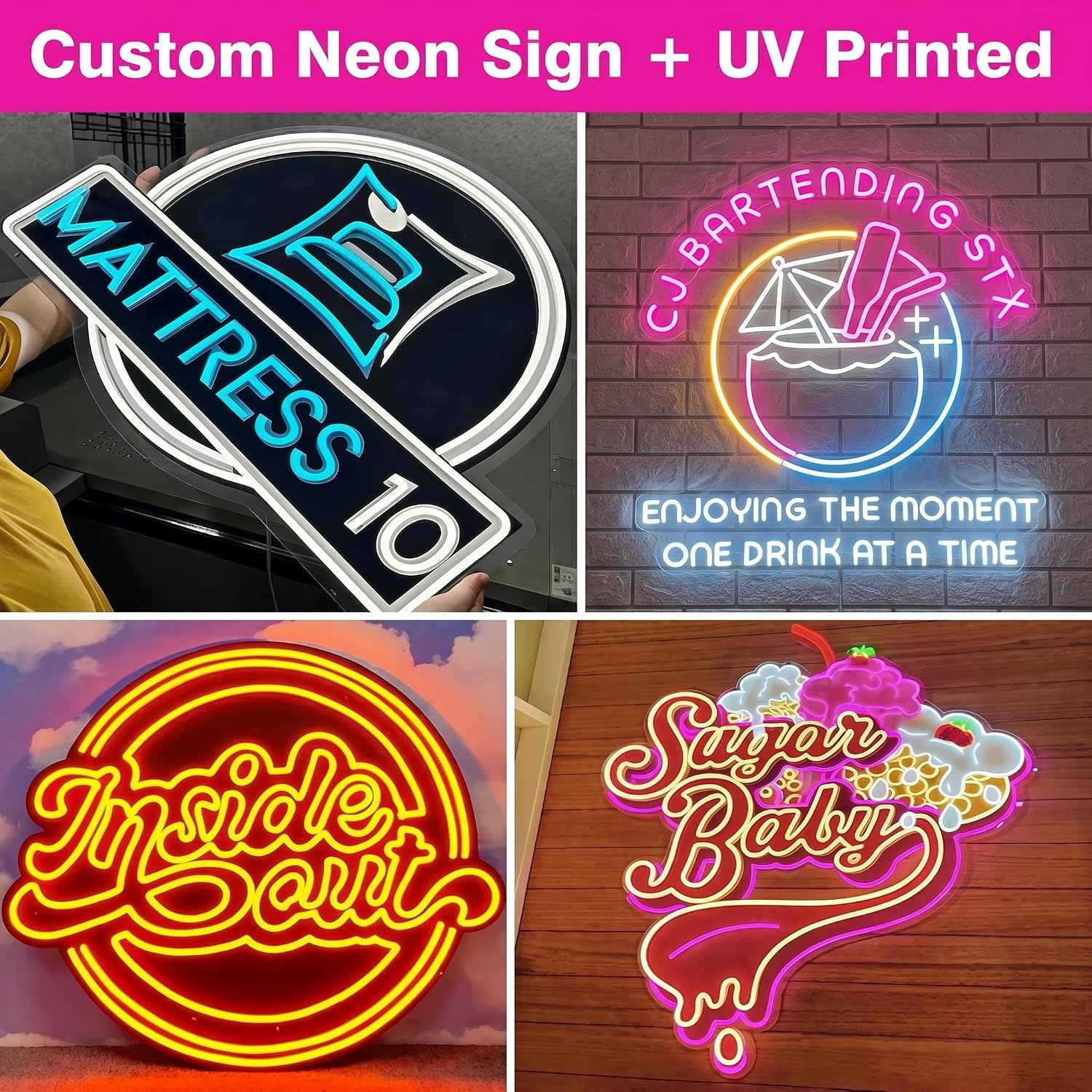
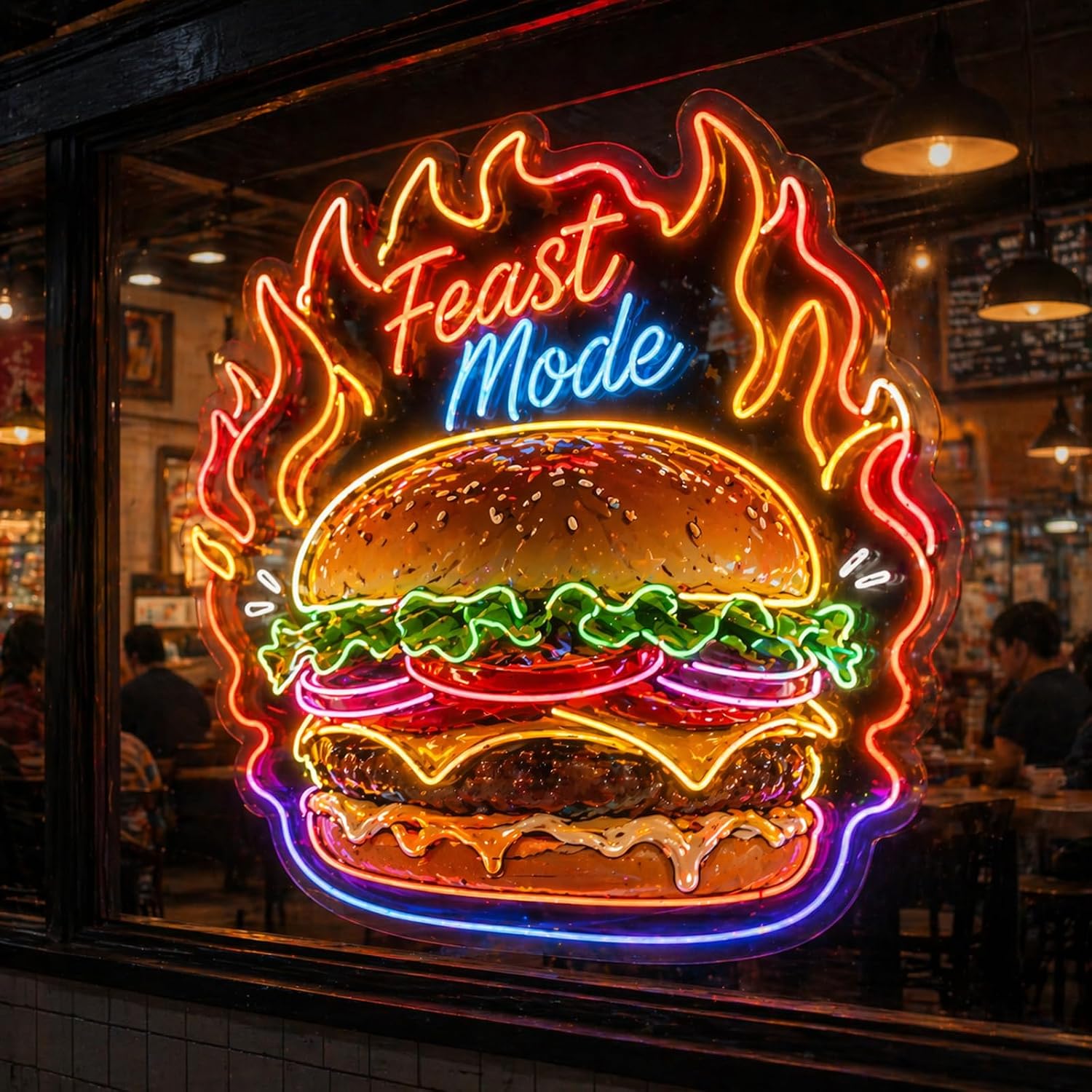
This format starts from the same LED flex tubing used in traditional bent-neon-style signs, but instead of silicone tube being shaped into letters, a UV inkjet printer deposits full-color artwork directly onto the surface of the flex strip. The result is a neon-style glow with the ability to reproduce photographic-quality logos, gradients, and multi-color artwork that traditional bent neon physically cannot achieve.
Signs of the Times (signs.org), in their production overview of UV printing on flex substrates, notes that UV-cured inks on silicone tubing maintain color accuracy under heat cycling across typical commercial operating temperatures — an important durability note for signs left on 8–12 hours daily.
Owners of UV-printed signs consistently flag excellent color vibrancy as the standout quality, and the format’s ability to reproduce complex artwork without the geometric limitations of bent tube is the clearest differentiator. The one meaningful complaint that surfaces in aggregated reviews: remote-controlled timer intervals max out too short for some operators’ preferences — a firmware and hardware limitation worth flagging to your vendor before ordering if you want a full-day auto-on cycle.
Architectural Digest, in their feature on how LED neon became a commercial design staple, notes that the format’s neon aesthetic reads as “approachable and energetic” — the opposite pole from acrylic’s corporate precision. Bars, music venues, fitness studios, and experiential retail are the natural habitat.
The Cost-and-Scale Decision Matrix
Here’s where the practitioner decision gets concrete. These are not equivalent formats at equivalent price points — they serve different scale and complexity requirements. The three tiers below map to the three most common buyer scenarios: budget-constrained small business, mid-range permanent install, and premium or complex-artwork application.
Budget Applications: Under $300, Simple Artwork
At this price tier, acrylic backlit panels offer more finished sign for the dollar. A single-color or two-color wordmark cut from 4mm acrylic with a direct-backlit LED array reads cleanly on a reception wall or retail shelf and arrives with standoff hardware included. UV-printed flex at this price point exists but tends toward smaller dimensions and simpler controller hardware — the format’s color-reproduction advantage is underutilized when artwork complexity is low.
Best fit: Nursery name signs, home office monograms, small retail shelf logos, pop-up event nameplates with simple artwork.
SELICOR
$50.95
In stock on Amazon
Check price on AmazonMid-Tier Applications: $300–$600, Permanent Install
This is the most contested range, and both formats perform well here with different strengths. Acrylic backlit panels in this range typically scale to 24”–48” wide with more sophisticated edge treatments and thicker acrylic stock. UV-printed flex in this range unlocks larger tube diameters, higher-output transformers, and better remote-control hardware. The decision comes down to brand personality: corporate and architectural lean acrylic; energetic and bar-adjacent lean flex.
Per Business Insider’s ranked guide to custom neon signs for businesses, operators sourcing for permanent installs should budget at minimum $400–$600 for a quality flex unit with a properly rated transformer — not the sub-$150 price point that floods search results and typically involves undersized drivers.
Best fit: Salon feature walls, boutique reception desks, fitness studio branded walls, restaurant host-stand signage.
Custom
$55.98
In stock on Amazon
Check price on AmazonPremium Applications: $600 and Above, Complex Artwork or Event Rental
Above $600, UV-printed neon flex earns its premium through artwork complexity and physical resilience. Gradients, photographic-quality crests, AI-generated multi-color monograms, and brand lockups with more than three color zones all reproduce natively on flex — acrylic at this complexity requires additional production steps that raise cost without matching the neon aesthetic. For signs that will move between events, pop-up installs, or rental deployments, flex tube survives repeated handling that rigid acrylic panels do not.
Dezeen, in their coverage of LED neon’s rise in commercial interiors, emphasizes that the design collaboration step — brief to proof to approval — is where fabricator quality separates from commodity suppliers. At premium price points, a vendor who cannot produce a scaled proof with dimension callouts on a wall-toned background render is not delivering what the tier requires.
Best fit: Event rental props, multi-color brand crests, gradient logo lockups, trade show display signage, venue installations with complex artwork.
Custom
$62.89
In stock on Amazon
Check price on AmazonComparison Summary
| Scenario | Better Format | Tier |
|---|---|---|
| Single-color wordmark, under $300 | Acrylic backlit | SELICOR — $50.95 |
| Reception wall logo, 24”–48”, permanent | Acrylic backlit | Custom — $55.98 |
| Bar logo with gradient or multi-color lockup | UV-printed neon flex | Custom — $55.98 |
| Event rental prop, moved frequently | UV-printed neon flex | Custom — $62.89 |
| Retail window sign, daytime visibility priority | Acrylic backlit | Custom — $55.98 |
| AI-generated multi-color monogram or crest | UV-printed neon flex | Custom — $62.89 |
The Proof Process: Why It Matters More Than You Think
Multiple owners across both format categories cite the pre-production mockup approval step as the single biggest trust signal when ordering custom signage sight-unseen. For a $400–$1,500 order, the proof stage is where you catch color drift, proportion issues, and file interpretation errors before anything goes into production.
Standard practice from quality fabricators is a digital mockup rendered at scale within 24–72 hours of order. Owners consistently report this process reduced ordering anxiety substantially — particularly for first commercial installs where the buyer has no physical sample to reference.
Dezeen’s reporting on LED neon’s commercial rise emphasizes that vendors who send a flat white-background PNG with no dimension callouts are not delivering a proper proof. Push for scale dimensions and a render on a wall-toned background before you approve. At any price tier, skipping the proof step is the single most common source of dissatisfied installs.
For buyers working from AI-generated artwork or vector files exported from generative design tools: this workflow is fully supported by most fabricators. The key is file format — request that your fabricator confirm they can accept SVG or high-resolution PNG at 300 DPI minimum, and verify the proof shows color zones accurately before signing off. If your AI-generated file uses gradients or complex overlapping shapes, UV-printed flex handles those natively; acrylic backlit signs typically require simplification to two or three clean color zones.
Mounting, Cord Management, and Installation Reality
Owners across both formats report two consistent positive surprises: signs arrive faster than expected and look larger than anticipated — both comments that appear unprompted in reviews and suggest fabricators’ listed dimensions read conservatively in real life.
On mounting hardware: most quality acrylic backlit signs ship with standoff hardware — the small metal posts that hold the panel away from the wall, creating a shadow gap that enhances the floating-letter effect. Wall anchors are typically not included. Plan to supply your own based on your wall substrate. Drywall anchors for panels up to 5 lbs are standard hardware-store items; for heavier panels or masonry walls, source toggle bolts or masonry anchors before your install day.
Cord management on acrylic panels mounted on finished walls is the most common installation question from owners. The cleanest solutions based on aggregated owner experience:
- Surface raceway channel (paintable plastic channel that runs the cord to a baseboard outlet) for walls where you cannot route in-wall
- In-wall cord routing through a low-voltage brush plate if the wall is accessible from behind
- Furniture placement — for signs positioned above a console or credenza, the cord runs behind the furniture to a hidden outlet
UV-printed flex signs with their softer, tubular profile tend to be wall-hung on cleats or wire systems with the transformer placed at the base — easier to dress than a rigid panel, and the cord tucks more naturally behind the sign’s mounting hardware.
Frequently Asked Questions
Can I upload an AI-generated or vector logo file for a custom neon sign?
Yes — most fabricators accept SVG, PDF, AI (Adobe Illustrator), and high-resolution PNG files. If your artwork originated in an AI image generator, export it at 300 DPI minimum or have a designer trace it into a vector format before submitting. For UV-printed flex, gradients and complex artwork reproduce natively. For acrylic backlit, simplify to clean color zones for best results.
What is the difference between an acrylic backlit sign and a UV-printed neon flex sign for a business logo?
Acrylic backlit signs project light through or behind a rigid plastic panel — clean, architectural, and well-suited to reception walls and retail fixtures. UV-printed neon flex signs use color-printed LED tubing to reproduce full-color logos with a neon glow aesthetic. The acrylic format reads corporate and permanent; the flex format reads energetic and approachable. Choose by brand personality and install context, not just price.
How long does the custom proof and production process take before shipping?
Based on owner-reported timelines, expect a digital proof within 24–72 hours of order, approval turnaround same-day or next-day, and production plus shipping completed in 5–10 business days for standard orders. Rush production is available from many fabricators at additional cost.
Will a logo neon sign be bright enough to see from outside through a window?
Acrylic backlit panels with direct-facing LEDs perform well in window-facing installs; edge-lit panels lose some punch against strong daylight. UV-printed flex signs produce warm ambient glow that reads best in lower-light environments — strong at night through a window, less competitive against afternoon sun without a high-output transformer spec. If daytime window visibility is a priority, ask your fabricator for lumen output specs and specify a direct-backlit rather than edge-lit acrylic panel.
What mounting hardware is included and do I need to supply my own wall anchors?
Most acrylic backlit signs ship with standoff posts but not wall anchors. UV-printed flex signs typically include hanging wire or cleats. Wall anchors for your specific substrate — drywall, plaster, masonry — should be sourced separately before install day.
How do I hide the power cord on an acrylic logo sign mounted on a finished wall?
The three practical options owners use: paintable surface raceway channel routed to a baseboard outlet, in-wall routing through a low-voltage brush plate if wall access allows, or furniture placement to conceal the cord run. For new buildouts, have your electrician install an outlet directly behind the sign’s planned position before finishing the wall.
The Decision Rule
If your brand identity is clean, typographic, and permanent — and the install is a reception wall, retail fixture, or any context where “polished studio” is the read — go acrylic backlit. The floating-letter effect delivers a premium visual result at a price point that surprises owners on the upside, and the long-rated driver life documented by Sign Media Canada’s LED Signage Buyer’s Guide 2025 justifies the install labor on a permanent buildout.
If your logo involves gradients, multi-color artwork, or a neon-bar-energy aesthetic — or if the sign will move between events, pop-ups, or rental installs — go UV-printed neon flex. The format’s color reproduction, as detailed in the Signs of the Times production overview of UV printing on flex substrates, handles complexity that acrylic cannot, and the flex tube’s physical resilience is better suited to repeated handling. Verify the remote timer range with your vendor before ordering if you need a full-day auto-on cycle.
When the budget is under $300 and the artwork is simple, acrylic wins on value. When the artwork is complex and the aesthetic is intentionally energetic, flex earns its premium. The proof process is non-negotiable at either tier — any fabricator who skips it is a vendor to skip.